Miami County Property Lookup: Search Owners, Parcels, Records and Maps
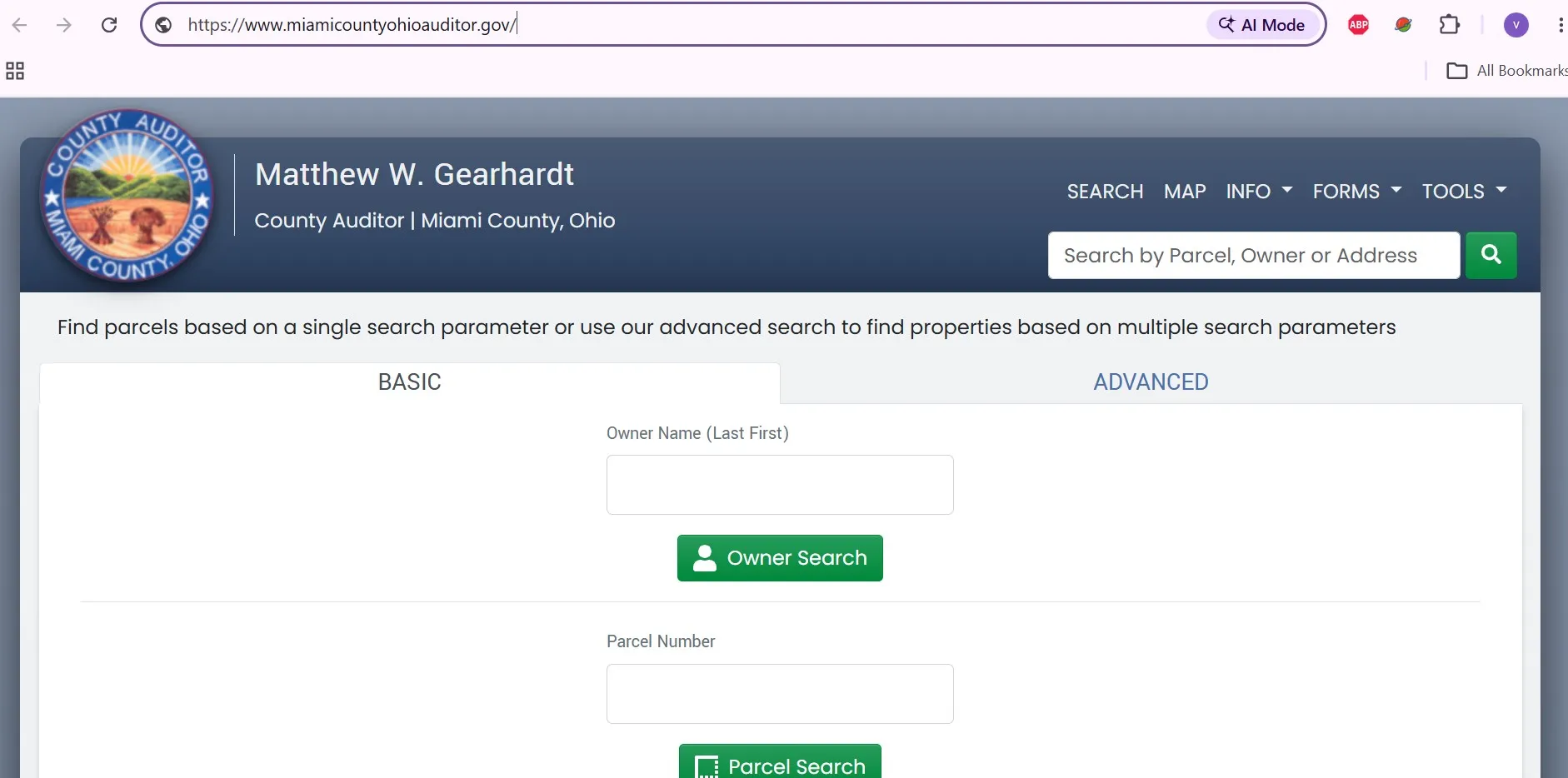
The Miami County Auditor property system can locate a parcel by owner name, street address or parcel number and display valuation, legal, land, building, sale, tax, exemption and mapping information.
This guide explains the record inside the page, including current 2026 tax deadlines, the 2025 reappraisal, Board of Revision evidence, Homestead, CAUV, damaged-property relief and deed-transfer steps.
201 W Main St.
Troy, OH 45373
Monday-Friday
8 a.m.-4 p.m.
About 54,700 county parcels.
Owner, address, parcel, sales and advanced filters.
What do you need from the Miami County Auditor?
Use the official search by address, owner name or parcel number.
Find the parcel through the Auditor, then use the Treasurer for the live bill and payment.
Check appraisal details, property characteristics, valid sales and the parcel map before contacting the county.
Auditor, Treasurer, Recorder or Board of Revision?
| What you need | Correct office | Prepare first |
|---|---|---|
| Owner, address, parcel, value or building information | Miami County Auditor | Address, owner name or parcel number. |
| Tax bill, due date, payment, penalty or delinquency contract | Miami County Treasurer | Parcel number, tax year and payment record. |
| Deed, mortgage, lien, release, easement or recorded image | Miami County Recorder | Owner name, book/page, instrument number or date. |
| Formal complaint about appraised market value | Miami County Board of Revision | DTE 1, requested value and evidence. |
| Exact boundary, fence or encroachment determination | Licensed surveyor, title professional or attorney | Deed, plat, legal description and survey records. |
How to search Miami County property records correctly
No result found? Follow this order
Miami County advanced property and sales search
Advanced search is useful when you need a group of properties rather than one known parcel. The official system can combine sales, location, land and residential criteria.
| Filter group | Available criteria | Useful research task |
|---|---|---|
| Sales | Sale dates, price range, buyer, seller and valid-sale status. | Find recent arm’s-length sales for market research or value review. |
| Location | Tax district, township, municipality, school district and neighborhood. | Compare properties within the same taxing or appraisal area. |
| Land | Property class and acreage range. | Research farms, vacant land, commercial land or similarly sized parcels. |
| Residential | Year built, living area, bedrooms, full baths and half baths. | Build a more comparable set of residential properties. |
How to read a Miami County Auditor parcel record
| Record field | Meaning | What to check |
|---|---|---|
| Parcel number | The county identifier for the tax parcel. | Use it across Auditor, Treasurer, map and form systems. |
| Owner | The ownership name currently carried by the Auditor. | Compare with the latest recorded deed after a recent transfer. |
| Property address | The physical location associated with the parcel. | Do not confuse it with the tax-mailing address. |
| Legal description | The recorded description identifying the land. | Use the deed, plat and survey for legal boundary decisions. |
| Appraised value | The Auditor’s estimate of full market value. | Review land and improvements separately. |
| Assessed value | Ohio generally taxes real property using 35% of appraised value. | This is not the same as the final amount of tax due. |
| Residential characteristics | May include year built, style, area, rooms, baths, basement and condition. | Identify factual errors before a value-review deadline. |
| Additions and improvements | Garages, decks, sheds and other structures may be listed separately. | Confirm removed or damaged structures are not still carried incorrectly. |
| Sales history | Buyer, seller, date, deed type, parcel count, price and validity. | A quitclaim, family, sheriff or exempt deed may not show market value. |
| Tax section | May display annual tax, half-year amounts, credits, assessments and payments. | Use the Treasurer for the live payable balance. |
| Homestead or owner occupied | Shows whether a tax-reduction status is connected with the parcel. | Verify an approved reduction appears after processing. |
| Photograph, sketch and map | Visual property and parcel references. | They help research but do not replace an inspection or legal survey. |
Miami County Auditor map, GIS and boundary research
The official map is useful when an address is incomplete, several parcels share a location, land has an unusual shape or neighboring parcels need to be compared.
Find parcels, compare nearby land, understand general shape and connect a map location with a parcel record.
Use a licensed surveyor and recorded instruments for boundary, access or encroachment disputes.
The Auditor homepage also links to current FEMA flood maps for broader hazard research.
Miami County 2025 reappraisal and 2026 property-tax records
Miami County completed its countywide real-property reappraisal for tax year 2025. The current Auditor record and the 2025 tax estimator provide the value and tax-year context used for taxes payable during 2026.
Reviews property data and market evidence to estimate what property would sell for on the open market.
Land value, improvements, square footage, year built, condition, class, acreage and recent sales.
The appraisal does not independently set every levy, special assessment, credit or tax-payment deadline.
Why your bill may not change by the same percentage as value
Factual error versus value disagreement
Examples include wrong square footage, incorrect acreage, a demolished building, incorrect property class or outdated ownership. Contact the relevant Auditor department with proof.
The physical record may be correct, but recent sales, condition or appraisal evidence may support a different market value. Prepare evidence for review or Board of Revision.
Miami County property-tax due dates, payment methods, fees and penalties
| Method | Official instructions | Important check |
|---|---|---|
| Send the bill stub and check payable to Jim Stubbs, Treasurer. | Use a U.S. Postal Service postmark by the due date; private-meter dates do not control. | |
| In person | Treasurer, 201 W Main Street, First Floor, Troy; Monday-Friday, 8 a.m.-4 p.m. | Complete payment by the collection deadline. |
| Night deposit | A night deposit box is located on the east side of the Safety Building. | Do not deposit cash and identify the parcel clearly. |
| Card | Online card payments are available through the county-linked provider. | The posted convenience fee is 2.50% of the transaction. |
| eCheck | Electronic-check payment is available online. | The posted eCheck fee is $1.99. |
| Delinquency contract | The Treasurer states that delinquent payment contracts may be available. | Call the office for eligibility, terms and current collection status. |
Late-payment penalty guidance
The Treasurer FAQ describes a 5% penalty during the first ten days after the deadline.
The Treasurer FAQ describes a 10% penalty on unpaid current tax after that initial period.
Miami County Board of Revision filing and evidence guide
A Board of Revision complaint addresses the property’s full market value, not simply the number of tax dollars charged. Miami County directs taxpayers to file DTE Form 1 between January 1 and March 31.
DTE Form 1 completion checklist
Evidence the Board may request or consider
| Evidence | What it helps establish | What to include |
|---|---|---|
| Recent sale | Market price for the subject property. | Purchase agreement, escrow or closing statement and explanation of related-party interests. |
| Professional appraisal | Opinion of market value as of a specific date. | Complete report, assumptions, comparable sales and appraiser credentials. |
| Comparable sales | Market evidence from similar properties. | Sale date, price, parcel, location, size, age, condition and adjustments. |
| Condition photographs | Physical problems not apparent in county data. | Dated exterior and interior images that identify the property. |
| Construction or repair costs | Cost and scope of improvements or serious defects. | Contracts, invoices, certified estimates and completion dates. |
| Income property records | Economic performance of commercial or rental property. | Leases, rent rolls and detailed income and expense statements. |
Hearing and evidence rules users often miss
Miami County Homestead Exemption and owner-occupancy reduction
Qualifying seniors, disabled homeowners and surviving spouses may shield $29,000 of market value.
Qualifying disabled veterans and certain public-service-officer surviving spouses may receive a $58,000 reduction.
New standard-program applicants generally use a maximum of $41,000 in 2025 Ohio modified adjusted gross income.
Standard eligibility checkpoints
Documents to prepare
| Applicant situation | Documents | Important detail |
|---|---|---|
| Senior applicant | Proof of age, parcel number and ownership information. | The applicant must meet the age rule during the application year. |
| Disabled applicant | DTE 105E or qualifying state/federal disability certification. | The disability must meet the permanent-and-total definition. |
| Income verification | Ohio income information or other evidence when returns were not filed. | Applicant and spouse income may both be included. |
| Trust, life estate or land contract | Relevant trust, deed, life-estate, mortgage or land-contract pages. | The documents must establish an eligible ownership interest and right to occupy. |
| Disabled veteran | DD-214, qualifying award letter and enhanced-exemption application. | The veteran program has separate service-connected disability rules. |
Application deadline
File on or before December 31 of the year for which the exemption is requested.
File on or before December 31 of the year before the exemption year.
Owner-occupancy tax reduction
An owner who occupies the property as a principal domicile on January 1 may apply for the owner-occupied reduction. A homeowner and spouse may receive the reduction on only one home, and the calculation generally applies to the dwelling and up to one acre.
Miami County CAUV and Agricultural District requirements
Current Agricultural Use Valuation values qualifying farmland according to agricultural use rather than a potentially higher development value. Agricultural District status is a separate program with protections related to nuisance suits, certain assessments and eminent-domain review.
| Program item | Official requirement | What the owner should retain |
|---|---|---|
| Agricultural-use history | Qualifying use during the three calendar years before application. | Crop, livestock, lease, conservation and production records. |
| Ten acres or more | At least ten acres devoted exclusively to qualifying agricultural use. | Acreage records, maps and evidence of use. |
| Less than ten acres | Average yearly gross agricultural income of at least $2,500, or evidence of anticipated income. | Sales receipts, farm schedules, leases and income records. |
| Federal conservation land | Land may qualify when devoted to an eligible federal retirement or conservation program. | Program agreements and payment records. |
| CAUV renewal | Renew annually by the first Monday in March. | A complete filed copy and proof of delivery. |
| Agricultural District | Renew every five years. | Application, acreage and qualifying-use documentation. |
| Conversion from agriculture | Can trigger recoupment equal to the prior three years of CAUV tax savings. | Conversion date, acreage and land-use records. |
Agricultural District benefits
May provide an affirmative defense when acceptable agricultural practices are followed.
Can defer certain water, sewer or electric assessments until land use changes or the land leaves the district.
Certain acquisitions involving agricultural-district acreage may receive additional state scrutiny.
Miami County damaged or destroyed property value reduction
When a building is substantially damaged or destroyed, the owner may apply for a temporary value deduction using DTE 26 for real property or DTE 49 for a manufactured home.
| Damage period | Typical filing deadline | Maximum proportional deduction |
|---|---|---|
| January through March | December 31 of the damage year | Up to 100% |
| April through June | December 31 of the damage year | Up to 75% |
| July through September | December 31 of the damage year | Up to 50% |
| October through December | January 31 of the following year | Up to 25% |
Evidence to collect immediately
Miami County conveyance fees, deed transfer and Recorder records
$2 per $1,000 of purchase price for a taxable transfer.
$0.50 per parcel transferred.
The Auditor states that checks must be written for the exact fee amount.
Which conveyance form applies?
| Form | General purpose | Important check |
|---|---|---|
| DTE 100 | Statement of value for a regular taxable real-property transfer. | Report the actual consideration and parcel information accurately. |
| DTE 100EX | Statement explaining a claimed conveyance-fee exemption. | Select the correct statutory exemption rather than assuming every no-money transfer is exempt. |
| DTE 101 | Additional statement involving Homestead property. | Confirm whether the grantor currently receives Homestead. |
| DTE 102 | Additional statement involving CAUV property. | Understand possible CAUV continuation or recoupment consequences. |
Transfer-to-record workflow
How to find a deed or mortgage
The Recorder’s basic search allows users to locate and view available deed, mortgage and encumbrance images without a copy charge.
Beginning January 2026, the Recorder lists a $2-per-page charge for copies supplied in person, by email or by mail. Prepayment is required.
Miami County sales, delinquency and tax-estimator tools
Search county sale activity within a selected date range.
Open weekly lists of sales marked valid for appraisal research.
Review the county’s published delinquency information, then confirm live status with the Treasurer.
Estimate tax-year 2025 taxes payable in 2026 by district, property type and reduction status.
Estimate transfer fees from sale price and parcel count.
Find BOR, CAUV, conveyance, destroyed-property, Homestead and owner-occupancy forms.
Miami County property-search and tax mini-tools
Property-search helper
Property-tax planning estimate
Conveyance-fee estimate
Correct-office finder
Miami County Auditor address, phone numbers and office map
201 West Main Street
Troy, OH 45373
Phone: 937-440-5925
Hours: Monday-Friday, 8 a.m.-4 p.m.
| Department | Phone | Call for |
|---|---|---|
| General Auditor | 937-440-5925 | General property, office and routing help. |
| Real-property appraisal | 937-440-5931 | Values, building data and property corrections. |
| Deed transfer | 937-440-5930 | Conveyance, transfer and owner-occupancy questions. |
| Homestead | 937-440-5929 | Homestead and manufactured-home reductions. |
| Board of Revision | 937-440-5928 | Formal valuation complaints. |
| CAUV and parcel splits | 937-440-5932 | Agricultural valuation, districts, splits and replats. |
| GIS | 937-440-5449 | Parcel-map and GIS assistance. |
| Treasurer | 937-440-6045 | Tax bills, payments and delinquency. |
| Recorder | 937-440-6040 | Deeds, mortgages, liens and official copies. |
How this Miami County guide was researched
Miami County Auditor property search, map, parcel records, reports, tax estimator, conveyance calculator, forms, Treasurer and Recorder.
DTE 1 complaint and instructions, DTE 105A Homestead application and county guidance for CAUV, Agricultural District, owner occupancy and conveyance.
Miami County Auditor property-search FAQs
Where can I search Miami County Auditor property records?
Use the official Miami County Auditor property-search page. It provides owner, parcel, address and advanced-search options.
How should I search by owner name?
Use last-name-first format. Start with the last name or distinctive business name, then add the first name or more words only when necessary.
Why did my address search return no result?
Remove the direction, street type, unit and punctuation. Enter only the house number and main street name before adding optional fields.
What information can I see in a parcel record?
Records may include ownership, parcel ID, legal description, values, taxes, land, structures, sales, exemptions, special assessments, photographs, sketches and map information.
Where do I pay Miami County property taxes?
Use the Miami County Treasurer’s official payment instructions. The Auditor provides property and tax-record information but does not collect the payment.
What is the 2026 second-half tax due date?
The real-property deadline was extended to August 20, 2026. The manufactured-home second-half deadline is August 31, 2026.
How do I challenge a property value?
Prepare the parcel record and market evidence, then file DTE Form 1 with the Board of Revision during the applicable January 1 through March 31 period.
What is the Miami County Homestead reduction?
The current standard program shields $29,000 of qualifying market value. Enhanced $58,000 programs apply to certain disabled veterans and eligible public-service-officer surviving spouses.
When is CAUV renewal due?
CAUV is renewed annually and is due by the first Monday in March. Agricultural District status is renewed every five years.
How much is the Miami County conveyance fee?
The Auditor lists $2 per $1,000 of taxable purchase price, plus a transfer fee of 50 cents per parcel.