Erie County Property Lookup: Find Owners, Parcels, GIS Maps and Tax Records
The Erie County Auditor property search is the practical starting point for finding an owner, property number, location, real-estate value, manufactured-home record, sale, transfer, tax district and parcel-map context.
This guide brings the important official rules into one place. Open a county system only when you are ready to run a live search, view a changing parcel record, pay taxes or submit a current form.
247 Columbus Ave.
Room 210, Sandusky
Monday-Friday
8 a.m.-4 p.m.
Name, location, number, sales and custom.
Second half due
July 29, 2026.
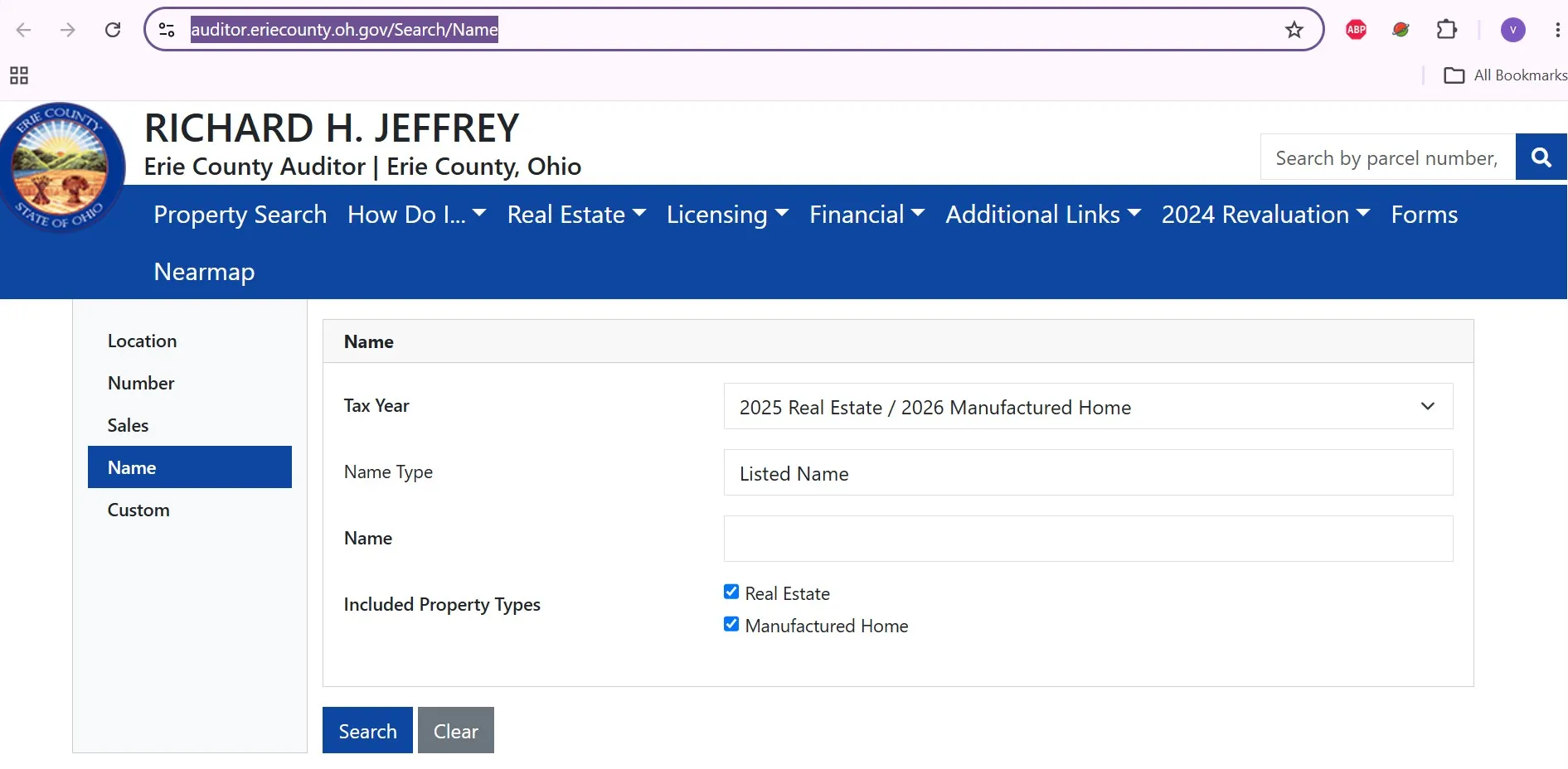
Screenshot of the official Erie County Auditor online property-search interface for Erie County, Ohio. The system includes Name, Location, Number, Sales and Custom searches, tax-year selection and options for real-estate and manufactured-home records.
What should you do first?
Search by location or owner, then copy the property number from the matching record.
Use GIS for map context, Treasurer for payment and Recorder for recorded documents.
Record the tax year, property number, values, status and data-update date before filing or paying.
Auditor, Treasurer, Recorder or Board of Revision?
| What you need | Correct office | What to prepare |
|---|---|---|
| Owner, property number, location, value or property characteristics | Erie County Auditor | Owner name, address or property number. |
| Tax balance, payment, receipt, penalty or delinquency | Erie County Treasurer | Tax bill and property number. |
| Deed, mortgage, lien, easement or recorded document | Erie County Recorder | Owner name, document number or recording date. |
| Formal complaint about market value | Board of Revision | DTE Form 1, requested value and evidence. |
| Fence, shoreline boundary, encroachment or acreage dispute | Surveyor, title professional or attorney | Deed, plat, survey and legal description. |
How to search Erie County property records without missing the result
No result found? Follow this order
How to read an Erie County Auditor property record
| Record field | What it means | Practical check |
|---|---|---|
| Property number | The county identifier for the parcel or property record. | Use it across Auditor, GIS, Treasurer and forms. |
| Listed name | The owner name carried for display or tax-record purposes. | Try deeded-name search when the listed name seems incomplete. |
| Deeded name | The ownership name associated with the recorded conveyance. | Use the Recorder when a certified deed or document image is needed. |
| Location | The physical property location. | Do not confuse it with the tax-mailing address. |
| Land use | The classification assigned to the property’s present use. | Verify residential, commercial, agricultural or vacant status. |
| Acres | The acreage carried in the Auditor record. | Use a survey and deed for legal acreage or boundary disputes. |
| Appraised value | The county’s estimate of full market value. | Review land and improvement values separately. |
| Taxable value | The assessed value used in Ohio’s property-tax calculation. | Ohio real estate is generally assessed at 35% of appraised value. |
| Tax district | The local taxing-area combination for the parcel. | Nearby parcels may have different effective tax rates. |
| School district | The school district connected with the tax parcel. | This can affect levies and Inflation Cap Credit eligibility. |
| Sale or transfer | Reported conveyance history and consideration. | Not every transfer is a normal arm’s-length market sale. |
| Building details | May include age, living area, stories, additions and improvements. | Document factual errors before contacting appraisal staff. |
Erie County GIS maps, Parcel Viewer, FEMA maps and historical tax maps
Erie County provides several map routes because a single parcel viewer cannot answer every lakefront, island, flood, survey or historical-boundary question.
| Map resource | Best use | Important limitation |
|---|---|---|
| Auditor GIS map | Parcel location, nearby properties and general map research. | Displayed lines are not a legal survey. |
| Erie County Parcel Viewer | Search by address, place, owner name or parcel number. | Recent transfers or map changes can take time to appear. |
| FEMA flood maps | Flood-zone and insurance-map research. | Confirm effective panels and site-specific determinations. |
| Historical tax maps | Older parcel configuration and tax-map research. | Historical mapping may not reflect current ownership. |
| Engineer’s surveys | Survey and engineering-document research. | Availability does not replace professional interpretation. |
| Open Data Portal | Downloadable GIS layers and public geographic datasets. | Check metadata and update dates before analysis. |
Lakefront and island-property checks
Erie County property-tax due dates, online payment fees and Inflation Cap Credit
Sandusky, OH 44870
How to pay online without applying payment to the wrong parcel
| Payment method | Processor fee | Practical note |
|---|---|---|
| Electronic check | $1.00 | Verify routing and account numbers carefully. |
| Credit card | 2.39%, minimum $2.00 | The fee is paid to the processor, not the Treasurer. |
| Debit card | 1%, minimum $1.50 | Review the total fee before authorizing payment. |
| Phone payment | Same processor schedule | Call 1-877-739-5989. |
| Mail by check | No online processor fee | Include the bill stub or write the parcel number on the check. |
Inflation Cap Credit: which Erie County districts may qualify?
House Bill 186 limits certain voted-millage growth in school districts operating at the 20-mill floor. The credit is automatic when the parcel and district qualify; no separate homeowner application is required.
Bellevue, Edison, Firelands, Huron, Monroeville, Vermilion and Western Reserve.
Kelleys Island, Margaretta, Perkins and Sandusky.
Why the 2024 Erie County revaluation still matters to current records
Erie County’s most recent full real-property revaluation was performed for tax year 2024. Final values were submitted to the state in October 2024, and bills reflecting those values began mailing in January 2025.
Check facts before assuming the value itself is wrong
Erie County Board of Revision filing, evidence and hearing rules
Fax: 419-627-7740
Sandusky, OH 44870
Filing and document rules extracted from county procedures
Evidence that can support a residential complaint
| Evidence type | How the Board treats it | Preparation tip |
|---|---|---|
| Closing statement and purchase contract | Useful when the sale was recent and arm’s length. | Include the conveyance statement and explain unusual sale conditions. |
| Market-value appraisal | Strongest when prepared for the January 1 tax-lien date. | Submit the complete appraisal, not only a value page. |
| Certified repair estimates | Major structural issues may affect value. | Routine age-related maintenance is usually already reflected in condition. |
| Comparable market analysis | Can help when supported by valid conveyance records. | Use similar, recent arm’s-length sales. |
| Commercial income records | Lease agreements, rent rolls and three years of income and expense data may be relevant. | Organize the records clearly and explain vacancies or unusual expenses. |
Items the evidence guide says are not accepted as value proof
Erie County Homestead Exemption eligibility and application preparation
Special applicant categories
A homeowner who received an Ohio Homestead credit for tax year 2013 remains exempt from the income test, even after moving within Ohio.
Qualifying totally disabled veterans may receive an enhanced reduction without the standard income requirement.
Qualifying surviving spouses of public-service officers killed in the line of duty may receive enhanced treatment.
Forms users may need
| Form | Purpose | When it matters |
|---|---|---|
| DTE 105A | Standard Homestead application. | Senior, disabled and qualifying surviving-spouse applications. |
| DTE 105E | Certificate of disability. | When permanent and total disability must be documented. |
| DTE 105G | Grandfather-status addendum. | When claiming prior Ohio Homestead participation. |
| DTE 105H | Financial addendum. | When the applicant did not file the expected Ohio income-tax return. |
| DTE 105I | Disabled-veteran Homestead application. | For qualifying veterans and eligible surviving spouses. |
| DTE 106B | Complaint involving Homestead or owner occupancy. | When challenging a denial or cancellation. |
Erie County 2.5% owner-occupied tax credit
The owner-occupied credit is separate from Homestead. The owner must own and occupy the home as the principal residence and apply between January 1 and the first Monday in June.
The qualifying homesite and home itself.
Rental property, corporation-owned homes, non-owner occupancy, excess acreage above one acre and certain commercial-use portions.
Erie County CAUV application, renewal, recoupment and qualifying uses
| Requirement | Official rule | Practical preparation |
|---|---|---|
| Initial filing period | After January 1 and before the first Monday in March. | Collect land-use and production records early. |
| Initial fee | $25. | Make the check payable as directed by the Auditor. |
| Annual renewal | Required every year before the first Monday in March. | Renew even when agricultural use has not changed. |
| Renewal fee | No fee for land already enrolled. | Return the mailed renewal or current county form. |
| Removal | Three years of prior tax savings can be recouped. | Contact the Auditor before changing use or failing to renew. |
| Accuracy | Knowingly false application information can be a first-degree misdemeanor. | Keep documentation supporting acreage, production and income. |
Examples from the Erie County CAUV guidance
Race-horse or saddle-horse raising may qualify as animal husbandry, but a racetrack does not.
A producing greenhouse may qualify when program income and use requirements are met.
A store that only resells agricultural products does not qualify as agricultural production.
Raising fish, shellfish or other aquatic plants or animals can qualify.
Beekeeping and the raising and care of bees can qualify.
On parcels of at least ten acres, timber may qualify when the commercial-production test is satisfied.
Erie County conveyance fees, transfer fees, lot splits and e-filing
$4 per $1,000 of sale price for real estate and manufactured homes.
$0.50 per legal-description line.
A qualifying exemption requires the current DTE 100 EX statement and supporting reason.
Before presenting a transfer
Erie County manufactured-home search, tax methods, transfer and relocation rules
Manufactured homes can be searched by registration number, owner or address. The tax and transfer rules depend partly on when the home was acquired and whether it uses the depreciation or appraisal method.
| Issue | Erie County rule | Next action |
|---|---|---|
| Home acquired after January 1, 2000 | Generally taxed using the appraisal method. | Review market value, 35% assessed value and effective tax rate. |
| Older home | May remain under depreciation or elect a one-time conversion. | Ask the Auditor to compare both methods before changing. |
| Convert home to real estate | Generally requires permanent foundation, common land ownership, paid taxes and title inactivation. | Coordinate with Auditor and title office before beginning. |
| Used-home transfer | Unpaid taxes must be paid and a $4-per-$1,000 conveyance fee applies. | Complete Auditor transfer before title transfer. |
| Move on a public road | A relocation notice is required and costs $5. | Pay all taxes and attach the notice to the rear of the home. |
| Failure to obtain relocation notice | A $100 fine may apply to the owner and another $100 to the mover. | Obtain the notice before movement begins. |
| Newly located in Erie County | Register with the Auditor within 30 days. | Failure can result in a $100 fine. |
| Value complaint | Homes under the appraisal method may use Board of Revision. | File DTE Form 1 during the January 1-March 31 period. |
Erie County short-term rental and lodging-tax registration
An owner operating lodging for transient guests must register the business within 30 days after beginning operations. Erie County uses LocalGov for registration, filing and payment.
The property owner submits the transient-occupancy registration.
One-time registration; no annual renewal is listed.
No fee is charged for the registration itself.
Erie County real-property downloads, reports and historical records
Excel-format county property data for users who need a structured research file.
XML-format data intended for larger or technical property-data analysis.
Useful for reviewing transfers and potential comparable sales.
Useful for appraisal-area and neighborhood-level research.
Useful when researching older parcel configurations and map history.
Shows case number, received date, tax year, school district and requested value change.
Erie County property-search, tax, value and conveyance mini-tools
Property-search method helper
Basic Ohio property-tax estimate
Property-value change calculator
Conveyance-fee estimate
Payment-fee comparison
Correct-office finder
Erie County Auditor address, phone, email, hours and map
Sandusky, OH 44870-2635
Fax: 419-627-7740
Monday-Friday
8 a.m.-4 p.m.
Check current notices before visiting on a holiday or filing deadline.
Bring these items before visiting
Related Ohio property-record guides
Internal links are limited to live pages that help users choose the correct county or understand the county-auditor process.
Official Erie County live-action resources
The operational rules are explained above. Use these official pages for current searches, forms, calculations, filings and payment.
Erie County Auditor property-search FAQs
Where can I search Erie County Auditor property records?
Use the official Erie County Auditor property-search system. It includes Name, Location, Number, Sales and Custom search options for real estate and manufactured homes.
How should I search by owner name?
Start with the owner’s last name or the most distinctive part of a business or trust name. Try both listed-name and deeded-name options when the first search fails.
How do I search by property number?
Use the official Number search and enter the property number from a tax bill, GIS result, deed file or existing Auditor record.
Where can I view Erie County parcel maps?
Use the official Erie County Parcel Viewer or the Auditor’s GIS, Maps and FEMA page for parcel, flood, historical tax-map and survey resources.
Are GIS parcel boundaries legally exact?
No. GIS is a research tool. Use a recorded deed, plat, title examination and professional survey for legal boundary decisions.
When are second-half Erie County taxes due in 2026?
Second-half real-estate and manufactured-home taxes are due July 29, 2026. Confirm the live parcel bill before paying.
How much does online tax payment cost?
The Treasurer lists a $1 electronic-check fee, a 2.39% credit-card fee with a $2 minimum, and a 1% debit-card fee with a $1.50 minimum.
How do I challenge the property value?
Use DTE Form 1 and the Board of Revision process during the official filing period. Support the requested market value with credible parcel-specific evidence.
What is the Erie County conveyance fee?
The county charges $4 per $1,000 of sale price, plus a transfer fee of 50 cents per legal-description line.
What are the Erie County Auditor office hours?
The office is normally open Monday through Friday from 8 a.m. to 4 p.m. at 247 Columbus Avenue, Room 210, Sandusky.