Wayne County Property Lookup: Parcels, 2026 Values, Taxes and Maps
The Wayne County Auditor property system can identify an owner, parcel or address, but the full record goes much further. It may show preliminary 2026 values, land and building details, tax calculations, sales, agricultural status, reductions, legal descriptions and GIS information.
This guide explains those details before sending you to a government portal. Use official systems only for the final live search, reappraisal appeal, tax payment, form submission, map request or property transfer.
428 W. Liberty St.
Wooster, OH 44691
Monday-Friday
8:00 a.m.-4:30 p.m.
Owner, parcel, address and manufactured-home registration.
Official information checked July 23, 2026.
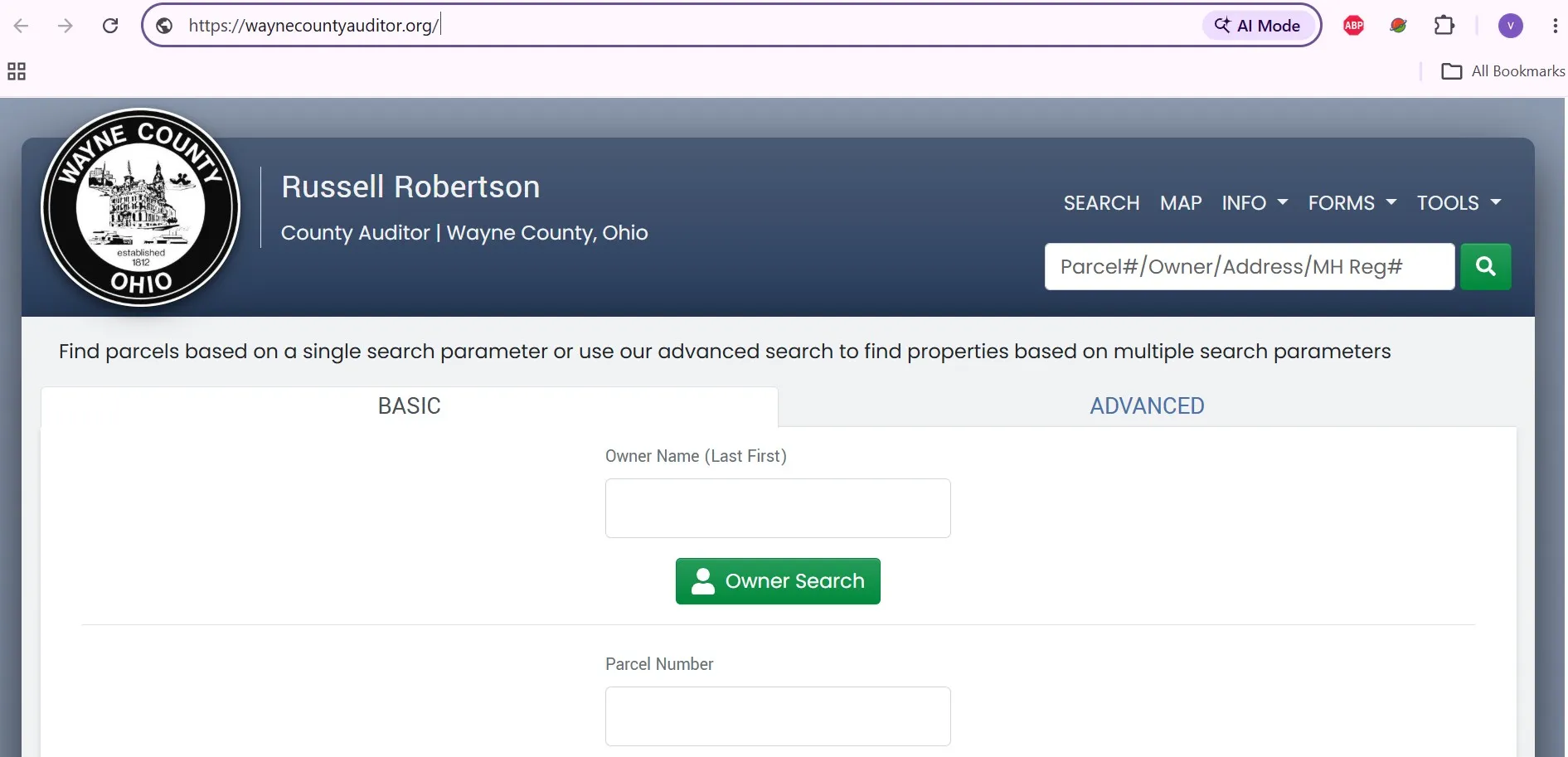
What do you need from the Wayne County property record?
Search by parcel, owner, address or manufactured-home registration and verify at least two identifiers.
Compare the proposed value with property facts, sales and market evidence before the August 7 informal-appeal deadline.
Use the parcel record to understand the bill, then use the Wayne County Treasurer for payment or balance questions.
Auditor, Treasurer, Recorder, Map Office or Board of Revision?
| What you need | Correct office | What to prepare |
|---|---|---|
| Owner, parcel, address, appraisal or property characteristics | Wayne County Auditor | Parcel number, owner name, address and the specific field in question. |
| Tax balance, due date, payment, receipt or delinquency | Wayne County Treasurer | Parcel number, tax bill, payment date and confirmation details. |
| Deed, mortgage, lien, release or recorded instrument | Wayne County Recorder | Owner name, document number, book/page or recording date. |
| Legal-description review, tax map or deed routing | Wayne County Map Office | Deed, legal description, parcel number and prior deed information. |
| Formal complaint about appraised value | Wayne County Board of Revision | Correct complaint form, requested value and supporting evidence. |
| Exact boundary, fence line or encroachment | Licensed surveyor, title professional or attorney | Deed, recorded plat, legal description and previous survey. |
How to search Wayne County property by owner, parcel or address
Which search method should you use?
Best for an exact match and for moving between property, tax, map and form systems.
Best for locating one or more parcels associated with a person, trust, estate or company.
Best when the physical location is known but the owner or parcel number is not.
Best for registration number, park and lot research.
Best for sales, neighborhood, acreage, building and market research.
Best when the approximate location is known but the typed record is unclear.
No result found? Follow this order
How to read a Wayne County Auditor parcel record
| Record field | What it means | What to verify |
|---|---|---|
| Parcel number | The county’s identifier for the tax parcel. | Use the complete number for taxes, GIS, deeds, appeals and forms. |
| Owner | The owner carried in the Auditor record. | Check Sales or the latest recorded deed when ownership appears outdated. |
| Site address | The physical address assigned to the parcel. | Do not confuse it with owner or tax-mailing addresses. |
| City or township | The local jurisdiction associated with the parcel. | Mailing city and township jurisdiction are not always identical. |
| School district | The school taxing district connected with the parcel. | Nearby parcels can have different districts and effective tax rates. |
| Appraised value | The Auditor’s estimated full market value. | Separate land, improvements and total value. |
| Assessed value | Generally 35% of appraised value for Ohio real property. | The bill is calculated using taxable assessed value and the effective rate. |
| Preliminary valuation | A proposed value that may still be undergoing 2026 reappraisal processing. | Review the reappraisal notice and appeal deadline before assuming it is final. |
| Legal description and acreage | The summarized legal and land information connected with the parcel. | Use the deed, plat and survey for legal-boundary decisions. |
| Land use | The county classification describing the property’s use. | An incorrect class can affect appraisal analysis. |
| CAUV status | Shows whether qualifying agricultural land is valued under current agricultural use. | Review full value, CAUV value and possible recoupment separately. |
| Homestead and owner occupancy | Shows whether tax-reduction status is connected with the parcel. | Confirm an approved benefit appears on the later tax bill. |
| Sales | Transfer dates, buyers, sellers, deed type, amount and validity information. | A zero-dollar, family or exempt transfer may not represent market value. |
| Tax section | Charge, reduction, effective tax, credits, assessments, penalties, paid and due amounts. | Read the complete calculation rather than only the gross charge. |
Wayne County GIS Parcel Viewer, tax maps and printed-map requests
The official GIS can search by owner, address or parcel number. Users can download available surveys or tax maps, measure length or area, annotate and print maps, view recent sales and turn map layers on or off.
Printed map sizes and official fees
| Map size | Price | Planning note |
|---|---|---|
| 8.5 × 11 inches | $1 | Useful for a basic parcel or neighborhood reference. |
| 11 × 17 inches | $2 | Provides more room for labels and nearby parcels. |
| 18 × 24 inches | $4 | Large-format plotter printing may take longer. |
| 24 × 36 inches | $6 | Useful for broader project or township context. |
| 36 × 48 inches | $8 | Largest listed standard print size. |
What to include in a custom map request
Wayne County 2026 reappraisal and August 7 informal appeal
Wayne County is completing a state-mandated sexennial reappraisal. Parcel pages may show a preliminary 2026 valuation beside prior values. The preliminary-value notice warns that some parcel splits, combinations, new construction and previous Board of Revision decisions may not yet be reflected.
Review these items before filing an informal appeal
Separate a property-data correction from a value disagreement
The record lists the wrong square footage, building, acreage, use or physical characteristic. Identify the exact incorrect field and attach documentation supporting the correction.
The physical record may be accurate, but the proposed value appears unsupported by a recent sale, appraisal, comparable properties or documented condition.
Wayne County Board of Revision filing and evidence workflow
A Board of Revision complaint is a formal public proceeding. The complainant carries the burden of proving the requested value. A complaint should identify the overvaluation, undervaluation, incorrect classification or other determination being challenged.
Fax: 330-287-5436
428 W. Liberty St.
Wooster, OH 44691
Evidence for a residential property complaint
| Evidence | How it helps | Common weakness |
|---|---|---|
| Recent purchase | Closing statement and purchase contract can establish an arm’s-length transaction near the lien date. | Submitting only an online listing or estimated value. |
| Professional appraisal | A complete recent appraisal explains comparable selection, adjustments and value reasoning. | Submitting only the final value page or an automated estimate. |
| Contractor estimates | Certified estimates can document serious repair needs affecting market value. | Treating routine maintenance as a dollar-for-dollar value loss. |
| Residential Data Form | Organizes property facts, condition and the basis for the requested value. | Leaving sections incomplete or inconsistent with the parcel record. |
| Photographs | Front, rear, interior and outbuilding photos can show condition not visible in county data. | Undated close-ups that do not identify the property or location. |
| Construction costs | Hard and soft costs can help explain value for new construction. | Providing an unsupported project total without invoices or scope. |
Additional evidence for commercial, rental or agricultural property
Wayne County property taxes, July 30 deadline and payment checks
The Treasurer accepts partial payments toward current taxes, but the taxes must still be paid in full by the due date to avoid penalty.
Wayne County Treasurer, 428 W. Liberty Street, Wooster, OH 44691.
330-287-5450
Monday-Friday, 8:00 a.m.-4:30 p.m.
Tax record terms users often misunderstand
| Tax field | Meaning | User check |
|---|---|---|
| Charge | Gross tax before listed reductions and credits. | Do not treat it as the final amount due. |
| Reduction | Tax-reduction factors applied to qualifying levies. | Review the later effective-tax amount. |
| Effective tax | Tax after applicable reduction factors. | Credits and assessments can still alter the final bill. |
| Nonbusiness credit | A residential tax credit available to many qualifying nonbusiness parcels. | Commercial and industrial property may not qualify. |
| Owner-occupancy credit | A credit for a qualifying principal residence. | Confirm the home was owned and occupied on January 1. |
| Special assessments | Charges imposed for a specific public improvement or service. | Identify the assessing authority before disputing the charge. |
| Net owed, paid and due | The account calculation after charges, adjustments and recorded payments. | Compare with your receipt and contact the Treasurer about posting differences. |
Wayne County Homestead Exemption and owner-occupancy credit
Eligible homeowners may shield up to $29,000 of market value.
Qualifying disabled veterans may receive an exemption on up to $58,000 of value.
The Auditor lists an Ohio adjusted income limit of $41,000 for applicants subject to the income test.
Standard eligibility questions
Owner-occupancy credit
A qualifying owner-occupied home may receive a 2.5% tax reduction on eligible taxes for the dwelling and up to one acre of home site. The homeowner must own and occupy the property as the principal residence on January 1.
Wayne County CAUV acreage, income, forestry and recoupment rules
Current Agricultural Use Valuation values qualifying land according to agricultural use rather than ordinary market-development potential. It is a land-valuation program, not a blanket exemption for every rural parcel.
| Requirement | Official standard | Evidence to prepare |
|---|---|---|
| Agricultural history | Land must have been devoted exclusively to agricultural use for the three prior calendar years. | Crop, livestock, lease, production and land-use records. |
| Ten acres or more | At least ten qualifying agricultural acres may meet the acreage route. | Acreage, maps and agricultural-use documentation. |
| Under ten acres | Average annual gross agricultural income of at least $2,500, or evidence that this income is anticipated. | Gross-income worksheet, receipts, contracts and projections. |
| Conservation program | Qualifying federal land-retirement or conservation-program participation can provide another route. | Current agreement and payment documentation. |
| Annual renewal | Renewal applications are due by the first Monday in March each year. | Updated agricultural use and owner information. |
| Conversion | Land removed from qualifying use can trigger recoupment of the prior three years of tax savings. | Conversion date, acreage affected and future land-use plan. |
Woodland and forestry questions
Noncommercial woodland may qualify when it is contiguous with sufficient qualifying crop or pasture acreage.
Woodland managed for commercial timber may require a current Woodland Management Plan and sufficient acreage.
Do not assume a wooded residential parcel qualifies. Ask the Auditor how acreage, farm-unit size and management rules apply.
Wayne County manufactured-home search, title transfer and relocation
Manufactured homes are registered with the Auditor for taxation. The official search can use registration number, owner or address, and may display park, lot, year manufactured, make, model, serial number, assessed value and transfer history.
Two taxation methods
Historically used for manufactured homes before January 1, 2000, with statutory adjustments and depreciation applied to the sale price.
Homes taxed like real estate are appraised and generally assessed at 35%, with taxes billed through the regular real-estate cycle.
Manufactured-home title transfer steps
Relocating a manufactured home
Converting a manufactured home to real estate
Wayne County deed-transfer order, conveyance fees and 2026 form rules
A real-property transfer normally moves through the Map Office, Auditor and Recorder in that order. A deed that is incomplete, inconsistent or missing required conveyance information may be rejected before recording.
Published transfer and recording fees
| Fee | Published amount | Planning note |
|---|---|---|
| Conveyance fee | $4 per $1,000 | Value is rounded up to the next $100. |
| Transfer fee | $0.50 per parcel | Count every parcel included in the document. |
| Basic recording | $34 for the first two pages | Add $8 for each additional page. |
| Marginal notation | $4 | Applies when a qualifying marginal reference is required. |
| Document copy | $2 per page | Confirm certification cost separately when needed. |
| Nonstandard document | $20 | Correct formatting can prevent this additional fee or rejection. |
2026 deed-filing detail taken from the official county notice
428 W. Liberty St.
428 W. Liberty St., First Floor
Which Wayne County Auditor form should you look for?
| Property task | Common form or category | Prepare before filing |
|---|---|---|
| Challenge real-property value | DTE 1 and Residential Data Form | Requested value, evidence, signature and notarization. |
| Challenge a manufactured home taxed like real property | DTE 1M | Registration or parcel information and valuation evidence. |
| Apply for CAUV | DTE 109 and gross-income worksheet when required | Acreage, agricultural history and income records. |
| Renew CAUV | DTE 109A | Current use and owner information before the first Monday in March. |
| Place farmland in an Agricultural District | Form 11 | Farm acreage, use and owner information. |
| Apply for Homestead | DTE 105A and applicable addenda | Age, disability, income, ownership and residency documents. |
| Report damaged real property | DTE 26 | Damage date, photos, reports, estimates and parcel number. |
| Report a damaged manufactured home | DTE 49 | Registration information, damage date and condition evidence. |
| Request remission of a late-payment penalty | DTE 23A | Tax bill, payment evidence and the qualifying reason. |
| Taxable property transfer | DTE 100 | Complete all required conveyance information and exact consideration. |
| Exempt property transfer | DTE 100EX | Identify and explain the qualifying exemption. |
Damaged-property evidence checklist
Wayne County parcel, tax, map and conveyance mini-tools
Property-search helper
Ohio property-tax estimate
Conveyance-fee estimate
Printed-map fee helper
Correct-office finder
2026 value-change calculator
Wayne County Auditor address, phone numbers and office checklist
Monday-Friday
8:00 a.m.-4:30 p.m.
Check county holiday closures before traveling.
| Service | Contact | Use it for |
|---|---|---|
| Auditor main office | 330-287-5430 | Property search, appraisal, conveyance, CAUV and general routing. |
| GIS Department | 330-287-5411 | Map requests, GIS data, surveys and printed maps. |
| Board of Revision Clerk | 330-287-5433 | Formal complaint, hearing and filing questions. |
| Homestead | 330-287-5431 | Senior, disability, veteran and owner-occupancy questions. |
| Forestry | 330-287-5432 | Woodland and forestry qualification questions. |
| Treasurer | 330-287-5450 | Property-tax bills, payments, posting and delinquency. |
| Recorder | 330-287-5460 | Deeds, mortgages, liens and recorded documents. |
Nearby county auditor property-search guides
A Wooster-area mailing address or rural location can be close to a county boundary. Use these verified internal guides only when the parcel is actually located in the neighboring county.
Official Wayne County live-action resources
The important procedures, fees and troubleshooting steps are explained above. Use the links below for current searches, payments, calculations, applications and submissions.
Wayne County Auditor property-search FAQs
Where can I search Wayne County property records?
Use the official Wayne County Auditor search. It supports owner name, parcel number, address and manufactured-home registration searches.
How should I enter an owner name?
Enter the last name before the first name. For a business, trust or estate, begin with the most distinctive word and remove unnecessary punctuation.
How do I search by address?
Begin with the house number and main street name. Remove the direction, street type, unit and punctuation when an exact search returns no result.
Can I search manufactured-home records?
Yes. Search by registration number, park and lot information, owner or address.
What is the 2026 reappraisal appeal deadline?
Wayne County states that informal appeals of proposed 2026 reappraisal values must be filed by Friday, August 7, 2026.
Why is a 2026 value marked preliminary?
The reappraisal is still being completed. The parcel notice says preliminary values may not yet include all parcel splits, combinations, new construction or prior Board of Revision decisions.
When are second-half property taxes due?
Wayne County second-half real-estate taxes are due July 30, 2026.
Where do I pay Wayne County property taxes?
Use the Wayne County Treasurer. The Auditor provides parcel and tax-calculation information, while the Treasurer handles balances and payments.
How do I formally challenge a property value?
File the correct Board of Revision complaint during the January 1 through March 31 filing period and submit evidence supporting the requested market value.
Does the BOR complaint require notarization?
Wayne County’s instructions state that complaints must be signed and notarized. Call ahead when requesting in-person notary help from Auditor staff.
What is the Homestead income limit?
The Auditor lists an Ohio adjusted income limit of $41,000 for applicants subject to the income test, with a standard $29,000 market-value exemption and enhanced $58,000 disabled-veteran exemption.
What are the basic CAUV requirements?
Qualifying land generally needs at least ten acres in agricultural use, or land under ten acres must meet the $2,500 average annual gross-income test or another qualifying route.
How much is the Wayne County conveyance fee?
The Auditor lists $4 per $1,000 of value, rounded up to the next $100, plus 50 cents for each parcel.
Can the Wayne County parcel map establish my boundary?
No. GIS is an informational research tool. Use a recorded deed, plat and licensed surveyor for exact boundaries or encroachments.
What is the Wayne County Auditor’s address?
The office is at 428 West Liberty Street, Wooster, Ohio 44691. The main number is 330-287-5430 and regular hours are Monday through Friday from 8:00 a.m. to 4:30 p.m.