Summit County Property Lookup: Search Parcels, Values, Taxes, Deeds and Maps
The Summit County Fiscal Office property system can do much more than confirm an owner’s name. A complete parcel review can connect you with appraised value, taxes due, payment history, sales, building characteristics, permits, special assessments, recorded documents and official GIS maps.
This guide explains what each record means and which department handles the next step. Open an official system only when you are ready to run a live search, make a payment, register property, request a deed or submit a time-sensitive form.
175 S. Main St.
Akron, OH 44308
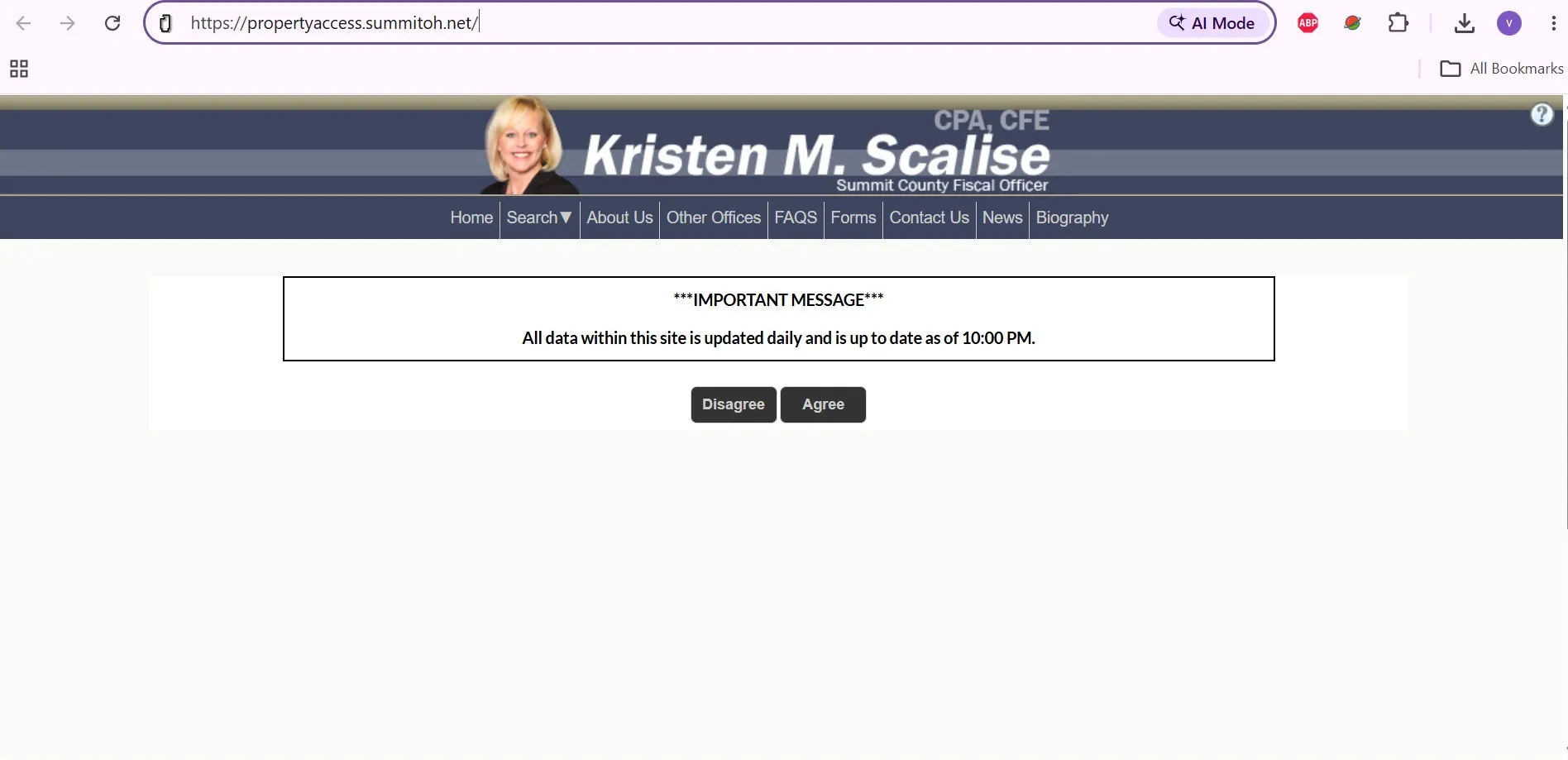
Official property data is updated daily through about 10 p.m.
January 1 through March 31.
Official information checked July 22, 2026.
What are you trying to do with the Summit County property record?
Use the official Property Tax and Appraisal system with a parcel number, address, owner name or advanced search.
Find the parcel first, then review taxes due, payment history or the official payment route.
Review record facts and 2026 reappraisal information before preparing a Board of Revision complaint.
Fiscal Office, Appraisal, Treasurer, Recording or Board of Revision?
Summit County combines several functions under the Fiscal Office. The service is still divided into departments, and contacting the wrong division can delay a time-sensitive payment, appeal or property transfer.
| User need | Correct route | Prepare before calling |
|---|---|---|
| Parcel, owner, address, appraisal or property characteristics | Property Tax & Appraisal / Appraisal Office | Parcel number, address, owner name and the specific record field in question. |
| Tax amount, payment, due date, receipt or delinquency | Treasurer Division | Parcel number, tax year, bill and payment-confirmation details. |
| Deed, mortgage, lien, release, plat or recorded instrument | Recording Division | Owner name, document number, recording date or parcel number. |
| Formal complaint about appraised market value | Board of Revision | DTE 1, requested value and evidence supporting that value. |
| Property transfer, deed conveyance or legal-description approval | Property Transfer / Conveyance | Proper deed, DTE 100 or DTE 100EX, legal description and exact fees. |
| Fence line, encroachment or exact legal boundary | Licensed surveyor, title professional or attorney | Deed, recorded plat, prior survey and legal description. |
How to search Summit County property by parcel, owner or address
Which search method is best?
Best for exact tax, title, map, transfer and appeal work.
Best for homeowners, buyers and users who know the physical location.
Best for finding one or more parcels connected with a person, trust or business.
Best for researchers who need to narrow broad results using several criteria.
Best when the approximate location is known but the typed address is uncertain.
Best when the goal is a deed, mortgage, lien, release or recorded instrument.
No result found? Follow this order
What you can find in a Summit County property record
| Record section | What it can show | What the user should check |
|---|---|---|
| Summary | Parcel, owner, location, classification and current overview. | Confirm that the record is the intended property before continuing. |
| Taxes Due | Current amounts associated with the parcel. | Verify the tax year and whether payment has posted. |
| Tax History | Prior tax-year charges and history. | Do not confuse prior-year billing with current calendar-year activity. |
| Payment History | Recorded tax-payment activity. | Compare payment date, amount and posting status with your receipt. |
| Special Assessments | Charges that may be separate from ordinary property-tax levies. | Identify the assessing authority before disputing a charge. |
| Values and Value History | Land, building, total and historical appraisal information. | Verify the value year and separate factual errors from market-value disagreement. |
| Sales | Transfer dates, consideration and available sale history. | Not every transfer is an arm’s-length market sale. |
| Land and structures | Land data, sketch, residential or commercial characteristics and outbuildings. | Square footage, use, year built, additions, garages and demolished structures. |
| Permits | Available permit-linked property information. | A permit does not always mean construction was completed exactly as proposed. |
| Map / Parcel Viewer | Parcel location and surrounding map context. | Use the map for research, not as a legal survey. |
| Recorded Documents | Links or references connected with recorded land records. | Open the actual recorded instrument when legal wording matters. |
Summit County Parcel Viewer, tax maps, plats and recorded-survey layers
The County of Summit Parcel Viewer can search by parcel number, owner name or street address. The county’s map tools also provide layers for parcel polygons, parcel lines, dimensions, lot numbers, land hooks, plats, old lots and recorded surveys.
Useful for general parcel location and nearby-property research.
Useful for finding available survey or subdivision references in the area.
GIS data is informational and does not replace a licensed survey or legal analysis.
Summit County 2026 reappraisal: what owners should review
Ohio requires a countywide reappraisal every six years and a value update in the third year after a reappraisal. Summit County’s Fiscal Office currently provides a 2026 Reappraisal Dashboard and virtual reappraisal information for this cycle.
Appraisal staff compare property characteristics and neighborhood market evidence. New construction can add value, but ordinary maintenance such as a replacement roof or routine remodeling does not automatically create the same type of value increase as a new building or major addition.
Check the property facts before arguing about market value
A listed building was demolished, square footage is wrong, the classification is incorrect or an improvement is missing. Contact Appraisal with documentation of the correct fact.
The physical data may be accurate, but the appraised value appears unsupported by a sale, appraisal, comparable market evidence or property condition. Prepare a value-review case.
Summit County Board of Revision filing rules and evidence checklist
Filing a Board of Revision complaint starts a legal proceeding. The property owner or complainant has the responsibility to prove the requested value. The Board reviews valuation; it does not decide whether the resulting tax amount is affordable or whether a tax payment was processed correctly.
Akron, OH 44301
Monday-Friday, 7:30 a.m.-4:00 p.m.
Evidence that can support a value complaint
| Evidence | How it helps | Weak submission to avoid |
|---|---|---|
| Recent purchase | A signed contract, closing statement and recorded deed can connect the sale to the parcel. | Only a listing page or an unsigned offer. |
| Professional appraisal | A complete appraisal can explain condition, comparable selection and value reasoning. | Only the appraiser’s final number without the report. |
| Comparable sales | Similar properties can demonstrate the market when adjusted for location, size, condition and date. | Using a nearby sale that is not genuinely comparable. |
| Condition documentation | Dated photographs and qualified repair estimates can show serious defects not visible in public data. | Undated close-ups with no parcel or room context. |
| Incorrect property facts | Plans, permits, demolition records, measurements or official documents can correct the appraisal record. | A verbal claim with no document supporting the correction. |
| Income information | Rent, vacancy, operating expenses and income records may be relevant for income-producing property. | Incomplete or unsupported income estimates. |
Summit County property-tax bill, July 31 deadline and payment-help programs
How to check and pay the correct parcel
| Payment route | 2026 practical detail | Important check |
|---|---|---|
| In person | Treasurer Division, 1 Cascade Plaza, Akron, OH 44308; weekdays 7:30 a.m.-4:00 p.m. | Bring the parcel number and confirm the current temporary office location. |
| U.S. mail | The envelope must be U.S. postmarked by July 31, 2026. | A private postage meter does not establish a timely payment date. |
| Online or phone | The official payment service requires the parcel number and charges a payment-method fee. | Use only the Fiscal Office payment route because fraudulent lookalike sites exist. |
| Participating bank | The branch must be in Summit County and listed in the tax-bill information. | Not every participating branch accepts cash. |
Tax bill fields that cause the most confusion
The first two digits identify the taxing district. Use the full number when contacting the office.
Ohio real-estate taxes are billed for the prior tax year, so the bill year and payment year can differ.
The bill may reflect reduction factors, nonbusiness credit, owner-occupancy credit, Homestead and other adjustments.
Current-payment and delinquent-payment help
For the July 31, 2026 cycle, qualifying owner-occupied parcels with current taxes may enroll by July 31 to avoid late-payment penalties. Call 330-643-2869.
A written monthly plan can freeze the delinquent balance from additional interest while the taxpayer follows the agreement and pays current taxes. Call 330-643-2600.
Owners with current taxes can prepay semiannual taxes through scheduled installments and may receive a discount credit from interest earned.
Summit County Homestead Exemption and owner-occupancy credit
Eligible homeowners receive an exemption on the first $29,000 of appraised value.
Eligible veterans receive an exemption on the first $58,000 of appraised value.
The Fiscal Office describes average Homestead savings of approximately $535 per year.
2026 standard eligibility checklist
Owner-occupancy tax reduction
The owner-occupancy credit is a reduction on taxes charged by qualifying levies. The applicant must own and occupy the home as the principal residence on January 1 of the filing year. Rental properties do not qualify.
Submit the owner-occupancy application by December 31 of the year in which the homeowner qualifies.
The credit remains until the property transfers or the owner tells the office it is no longer the primary residence.
Monday-Friday, 7:30 a.m.-4:00 p.m.
175 S. Main St.
Akron, OH 44308
Summit County recorded documents, deed copies and Property Record Alert
The appraisal record summarizes ownership and transfer information, but the Recording Division is the source for deeds, mortgages, liens, releases, easements, plats and other recorded instruments.
The online recorded-document system provides browser access to records from 1988 forward.
Older index books can be reviewed through the Index Book Archive Viewer.
A free email-alert service can monitor recordings connected with an individual or business name.
Do not overpay a private deed-copy solicitation
| Need | Official detail | Best next action |
|---|---|---|
| Ordinary deed copy | $4 according to the Fiscal Office deed notice. | Search online or request the copy from Recording Division. |
| Certified deed copy | Add $1 for certification. | State clearly that certification is required. |
| Mailed copy request | Include a stamped self-addressed envelope. | Provide the owner or document information needed to locate the deed. |
| Fraud monitoring | Property Record Alert sends automated email notices of matching recordings. | Register owner-name and relevant business-name variations. |
| Suspicious alert | An alert means a matching document was recorded; it does not by itself prove fraud. | Open the document and call Recording Division at 330-643-2712. |
175 S. Main St.
Akron, OH 44308
Monday-Friday, 7:30 a.m.-4:00 p.m.
Summit County conveyance, recording fees and document-preparation checks
The Property Transfer Department approves legal descriptions and conveyance information before a deed is recorded. The Fiscal Office accepts DTE Form 100 for taxable conveyances and DTE Form 100EX when a transfer qualifies for an exemption.
| Fee item | Published amount | Planning note |
|---|---|---|
| Basic recording | $34 for the first two pages | Add $8 for each additional page. |
| Noncompliant document | $20 per document | Prepare margins, names, signatures and formatting correctly. |
| Cross-reference | $4 each | Previously recorded documents may need accurate references. |
| Document photocopy | $2 per page | Certification adds $1 per document. |
| Conveyance fee | $4 per $1,000 | Sale price is rounded up to the next $100. |
| Lot fee | $0.50 per lot | Applies to exempt and nonexempt transfers. |
Recording-document checklist
Summit County residential rental registration and update rules
Residential rental property must be registered with the county even if the owner has already registered the property with Akron or another municipality. The county registration is a separate Ohio requirement.
Summit County describes this as a one-time registration with no fee.
Registered information must be updated within ten days after a change.
A violation can result in a special assessment of at least $50 and no more than $150.
Information the owner should prepare
Summit County damaged-property value deduction and filing deadlines
A property damaged or destroyed by fire, flood, storm, intentional demolition or another qualifying event may receive a temporary reduction in the value of the damaged portion through DTE Form 26.
File the application by December 31 of the damage year.
File by January 31 of the following year.
Build the evidence file before submitting
Summit County parcel-search, tax and conveyance mini-tools
Property-search method helper
Ohio property-tax planning estimate
Conveyance-fee planning estimate
Correct-office finder
Summit County Fiscal Office phone numbers, addresses and department locations
| Department | Phone and location | Use it for |
|---|---|---|
| Main Fiscal Office | 1-888-388-5613 175 S. Main St., Akron, OH 44308 |
General routing and Fiscal Office services. |
| Appraisal Office | 330-643-2710 175 S. Main St., Room 302 |
Property value, characteristics, reappraisal and appraisal-record questions. |
| Treasurer Division | 1 Cascade Plaza, Akron, OH 44308 | Tax bills, current payment and 2026 in-person tax collection. |
| Board of Revision | 330-926-2559 1180 S. Main St., Suite 250 |
Formal appraised-value complaints and hearing questions. |
| Homestead | 330-643-2661 175 S. Main St., Room 301 |
Homestead and owner-occupancy applications. |
| Recording Division | 330-643-2712 175 S. Main St., 4th Floor |
Deeds, mortgages, liens, recorded documents and Property Record Alert. |
| Rental Registry | 330-643-7561 175 S. Main St., Room 301 |
Residential rental registration and updates. |
| Damaged Property | 330-643-2704 175 S. Main St., Room 304 |
DTE 26 and storm, fire, flood or demolition deductions. |
Nearby county auditor and fiscal-office property searches
Properties near county borders can appear under a different county office than the mailing city suggests. These verified guides help users move to the correct neighboring county without creating repetitive keyword-only links.
Official Summit County live-action resources
The operational rules and user-help details are explained above. Use these official systems for current searches, payments, submissions, applications and final verification.
Summit County Auditor property-search FAQs
Where can I search Summit County property records?
Use the official Summit County Fiscal Office Property Tax and Appraisal system. It provides Property Search, Advanced Search, BOR resources and a tax estimator.
How current is the online property information?
The official system states that data is updated daily and current through approximately 10:00 p.m.
How do I search by owner name?
Start with the owner’s last name or the most distinctive word in an LLC, trust, estate or business name. Remove punctuation and unnecessary suffixes when the complete legal name fails.
How do I search by address?
Begin with the house number and main street name. Remove the direction, street suffix, apartment, unit and punctuation if no result appears.
Where do I view Summit County property maps?
Use the official Parcel Viewer. It supports parcel number, owner-name and street-address searching and includes parcel, lot, plat and recorded-survey layers.
Can I use the parcel map to settle a boundary dispute?
No. County GIS data is informational. Use a recorded plat, deed, legal description and licensed surveyor for fences, encroachments or exact boundary decisions.
When are second-half Summit County property taxes due in 2026?
The second-half 2025 real-estate tax deadline is July 31, 2026. A mailed payment must be U.S. postmarked by that date.
How do I challenge my Summit County property value?
Use the Board of Revision during the January 1 through March 31 filing period. Prepare DTE Form 1 and evidence supporting the requested market value.
Does a paper DTE 1 need to be notarized?
Yes. The county’s 2026 instructions state that a paper complaint must be dated, signed and notarized. An electronic SmartFile complaint is not subject to the notary requirement.
What is the 2026 Homestead income limit?
The official Summit County page lists a $41,000 household-income limit for means-tested 2026 applications. Certain grandfathered homeowners and qualifying disabled veterans are treated differently.
How do I obtain a Summit County deed copy?
Search official Recorded Documents or contact Recording Division. The Fiscal Office states that a deed copy costs $4 and certification adds $1.
How do I protect against property-record fraud?
Register for the free Property Record Alert system using the owner name and relevant business-name variations. Review every alert and contact Recording Division if a document appears suspicious.
How much is the Summit County conveyance fee?
The published fee is $4 per $1,000, with sale price rounded up to the next $100, plus a 50-cent fee for each lot in the legal description.
Does rental property need county registration?
Yes. Registration is required even when the rental is registered with a municipality. Summit County says the county registration is one-time and free, but changes must be reported within ten days.
Can damaged property receive a temporary value reduction?
Yes. File DTE Form 26 for qualifying fire, flood, storm, demolition or other damage. The deadline depends on when the damage occurred.