Hamilton County Property Lookup: Search Parcels, Values, Sales and Maps
The official Hamilton County Auditor property search can connect an address or owner name with parcel identification, appraisal details, transfer history, tax distribution, property images, sales information and related county records.
This guide explains how to search correctly, interpret the result, fix a failed search and choose the correct office. Open an official county page only when you are ready to perform a live search, submit a form, pay a bill or complete another live action.
138 E Court St.
Cincinnati, OH 45202
Monday-Friday
7:30 a.m.-4 p.m.
Owner, address, parcel ID, sales and advanced criteria.
Official sources reviewed July 22, 2026.
What do you need from the Hamilton County Auditor?
Use owner, street address or parcel ID search and verify the complete parcel record.
Find the parcel through the Auditor, then move to the Treasurer for bills, due dates and payments.
Review the property facts and market evidence before using Board of Revision procedures.
Auditor, Treasurer, Recorder, Board of Revision or surveyor?
| User need | Correct office | Prepare before contacting |
|---|---|---|
| Owner, address, parcel ID, appraised value or property details | Hamilton County Auditor | Owner name, address or parcel ID. |
| Tax bill, due date, balance, payment or mailing-address change | Hamilton County Treasurer | Parcel ID and tax-bill year. |
| Deed, mortgage, lien, easement or recorded document image | Hamilton County Recorder | Owner name, Auditor number, document number or date. |
| Formal complaint about appraised market value | Hamilton County Board of Revision | Requested value, evidence and filing-year information. |
| Exact boundary, fence line, encroachment or survey stakes | Licensed surveyor or qualified property professional | Deed, legal description, recorded plat and prior survey. |
| Zoning, permitted use, setback or building plans | Local city, village or township zoning/building department | Parcel ID, site address and project description. |
How to search Hamilton County property records correctly
Which search option is best?
Best for an exact match, official forms, tax research, transfers and cross-checking county systems.
Best for homeowners, buyers, renters and people who know the physical location.
Best for locating one or more parcels held by a person, estate, trust, LLC or organization.
Useful for market research, comparable sales, appraisal areas and recent transfer analysis.
Useful for narrowing multiple properties by available characteristics or assessment criteria.
Useful when an address does not match the parcel database or several parcels share one location.
No Hamilton County property result found? Follow this order
Official workaround for an address mismatch
How to read a Hamilton County Auditor property record
| Record field | What it means | What to verify |
|---|---|---|
| Parcel ID | The county identifier assigned to the taxable parcel. | Use the same number across tax, map, transfer and Recorder research. |
| Owner name | The legal ownership name currently carried in the Auditor record. | Compare with the latest Recorder deed when ownership appears outdated. |
| Site address | The physical property location associated with the parcel. | Do not confuse it with the owner’s tax-mailing address. |
| Appraisal information | Land, building and total fair-market-value components. | Review each component rather than only the total value. |
| Assessed value | Ohio tax-assessed value, generally 35% of appraised market value. | Do not multiply appraised value directly by a tax rate. |
| Property description | Assessment-related details such as use, structures, size and characteristics. | Check square footage, year built, stories, additions, garages and demolition. |
| Transfer history | Recorded ownership changes and reported consideration. | A zero-dollar or exempt transfer is not an open-market sale. |
| Value history | Prior appraised and assessed values. | Identify whether a change came from reappraisal, construction, demolition or correction. |
| Tax distribution | Current tax allocation and estimate information tied to the parcel. | Use the Treasurer for the actual current bill and payment balance. |
| Property images | Street-level or appraisal imagery collected for county valuation work. | An image date may not reflect recent repairs, damage or demolition. |
| Board of Revision | Case status, hearing date, decision or resolved date when available. | Check the current official filing year and appeal deadline separately. |
Hamilton County CAGIS maps, aerial imagery and property-line limits
CAGIS and Auditor aerial tools are useful for identifying parcel location, surrounding parcels, streets, building footprints and general property context. They are not legal boundary surveys.
Parcel identification, nearby-property context, approximate shape, aerial review and map navigation.
Do not place a fence, resolve an encroachment or establish ownership from a web map alone.
Contact the municipality or township for legal zoning, setbacks and permitted-use information.
Hamilton County’s 2026 triennial appraisal and January 2027 tax bill
Hamilton County completed a full reappraisal in 2023. The next step in the six-year valuation cycle is the 2026 triennial update, followed by the next full reappraisal in 2029.
Included physical viewing, property-characteristic verification and new street-level imagery.
Uses market sales and valuation analysis without a complete physical viewing of every parcel.
The Auditor FAQ says the 2026 values become effective on January 2027 tax bills.
Check these facts before disputing the value
Incorrect square footage, building description, ownership or demolition may require a record correction supported by documentation.
The record may be factually correct while the market value remains disputed. That issue requires market-value evidence.
Hamilton County Board of Revision evidence, hearing and appeal steps
138 E Court Street
Cincinnati, OH 45202
Monday-Friday
7:30 a.m.-4 p.m.
A complaint is a legal proceeding. Auditor staff cannot provide legal advice.
Evidence matched to the reason for your complaint
| Your value argument | Strong evidence | Weak or unusable approach |
|---|---|---|
| Purchased for less than Auditor value | Recent arm’s-length closing statement, purchase contract and sale appraisal. | An online listing or verbal sale-price statement without closing documents. |
| Similar homes sell for less | Recent comparable arm’s-length sales similar in size, age, type and location. | Comparing assessed values of neighboring homes that did not sell. |
| Serious structural or condition issues | Certified contractor repair estimates, dated photographs and a relevant appraisal. | Showing images only on a phone or laptop at the hearing. |
| Income-producing property earns less | Income statements, expenses, rent information and income-property appraisal. | A general statement that operating costs increased. |
Board of Revision timing rules users often miss
Hamilton County tax estimates, bills, due dates and payments
The Auditor provides property value and tax-distribution information. The Treasurer issues tax bills, accepts payments, handles due-date questions and updates the tax-bill mailing address.
Is the parcel, value, tax district, appraisal information or exemption status correct?
What is due, when is it due, was payment received or where should the bill be mailed?
How to estimate current-year taxes for a purchase
Hamilton County Recorder deeds, mortgages, easements and title alerts
Use the Auditor to identify the parcel and current ownership record. Use the Recorder when you need the recorded deed, mortgage, lien, release, easement, legal description or historical document.
| Question | Best starting record | Why |
|---|---|---|
| Who is listed as the current owner? | Auditor property record | Provides quick parcel and ownership lookup. |
| What does the deed legally say? | Recorder document image | The recorded instrument contains the legal conveyance language. |
| Is there an easement or mortgage? | Recorder search | These are recorded instruments, not only assessment fields. |
| What are the exact dimensions? | Deed legal description and survey | Auditor aerial and parcel lines are approximate. |
| Can I receive notice of title activity? | Recorder notification service | The Recorder manages Hamilton County’s recording-alert service. |
Hamilton County Homestead and owner-occupancy requirements
The county lists a 2025 household-income limit below $41,000 for eligible new senior or disabled applicants.
Homestead applications may be filed with the Auditor on or before December 31 of the current calendar year.
An approved Homestead or owner-occupancy reduction normally appears on the Auditor website in the following tax year.
Standard Homestead checklist
Enhanced disabled-veteran exemption documents
138 E Court Street
Cincinnati, OH 45202
Hamilton County CAUV eligibility, 2026 deadlines and renewal rules
| Requirement | County guidance | What to prepare |
|---|---|---|
| Commercial use | CAUV is for commercial agricultural production, not simply rural or hobby use. | Sales, production and income records showing profit intent. |
| Prior use | The land must meet qualifying agricultural-use history for the previous three calendar years. | Records for 2023, 2024 and 2025 for a 2026 application. |
| Under 10 acres | The farm must produce at least $2,500 in yearly gross agricultural income. | Gross receipts and records by year. |
| Initial fee | $25 one-time initial application fee; no annual renewal fee. | Check payable as directed by the current county page. |
| Annual renewal | Owners must reapply each year to remain in the program. | Current renewal form and continued-use proof. |
| Change in use | Nonqualifying use or failure to renew can trigger recoupment for up to three years. | Contact the coordinator before changing use or selling. |
Special CAUV details
Woodland cannot receive both CAUV and a separate forestry tax program benefit. A management plan may be required.
The county says apiculture can qualify and provides a one-acre agricultural-use credit per three bee hives.
The farm must meet the use history; the current owner does not necessarily have to own it for all three years.
Hamilton County residential rental registration and the 60-day update rule
Hamilton County administers Ohio’s state rental-registration program to maintain emergency contact information for rental-property owners or qualifying agents. It does not replace separate city, village or township rental programs.
The Hamilton County Auditor does not charge a fee for the state rental registration.
Required ownership or contact information must be updated within 60 days after a change.
A property identified as rental without a registration may receive a $150 penalty on a future tax bill.
Who must register?
Form details users commonly miss
| Form item | Hamilton County instruction | Common mistake |
|---|---|---|
| Owner name | Use the current deeded owner name shown in the Auditor record. | Filing before the property transfer appears under the new deeded owner. |
| Multiple properties | One form can list up to 12 rental properties; an additional page or spreadsheet may be used. | Leaving out parcel numbers or unit counts. |
| Business or trust ownership | Complete the corporate-officer and agent sections when the owner is an entity. | Listing only the LLC without a responsible contact. |
| Out-of-state ownership | List a qualifying in-state agent. | Providing only an out-of-state mailing address. |
| Property no longer rented | Consider the county’s non-rental acknowledgement process. | Ignoring the tax record after tenant occupancy ends. |
Monday-Friday
7:30 a.m.-4 p.m.
Hamilton County conveyance fees, required documents and payment rules
$3 per $1,000 of sale price or taxable consideration.
$0.50 per parcel described in the deed or legal document.
The official calculator lists cash or check, payable to the Hamilton County Auditor.
Documents explained from the official transfer standards
| Document | When it is used | What it tells the Auditor |
|---|---|---|
| DTE 100 | A conveyance subject to the real-property conveyance fee. | Grantor, grantee, property, consideration and tax-mailing information. |
| DTE 100EX | A conveyance claimed to be exempt from the conveyance fee. | The legal reason claimed for exemption and supporting facts. |
| Evidence of title | Usually a deed, court order or other title instrument. | Shows the grantor’s title source, grantee information and property description. |
| DTE 101 | When the grantor received Homestead treatment for the current or preceding tax year. | Helps address Homestead status during the transfer. |
| DTE 102 | When the property received CAUV for the current or preceding tax year. | Provides CAUV conveyance information and alerts the parties to potential recoupment. |
Payment and submission mistakes that can delay transfer
Fax: 513-946-4024
138 E Court Street
Cincinnati, OH 45202
Hamilton County Auditor downloads, sales files and public-record requests
The Auditor publishes downloadable public data including building information, tax-year information, historic sales, new construction, rental-registration exports, unpaid-account information and other county datasets.
Use the individual property record rather than downloading an entire county file.
Use sales, building or tax-year exports when researching many parcels or appraisal areas.
Describe the record, date range, department and preferred format as specifically as possible.
Hamilton County property-search and conveyance helpers
Choose a property-search method
Conveyance-fee estimate
Property-value change
Find the correct office
Hamilton County Auditor phone number, address, hours and department contacts
Cincinnati, OH 45202
Monday-Friday
7:30 a.m.-4 p.m.
Confirm holiday closures and department requirements before traveling.
| Department | Phone | Use it for |
|---|---|---|
| Auditor main line | 513-946-4000 | General property-search, valuation and Auditor routing. |
| Board of Revision | 513-946-4035 | Formal property-value complaint questions. |
| Homestead / Rental | 513-946-4099 | Homestead, owner occupancy and rental registration. |
| CAUV | 513-946-4120 | Agricultural valuation, renewal and qualification. |
| Transfer / Conveyance | 513-946-4015 | Deed transfers, forms, exemptions and Auditor fees. |
| Treasurer | 513-946-4800 | Tax bills, payments, due dates and billing address. |
Bring these details when visiting
Related Southwest Ohio county auditor guides
These contextual internal links are useful when a property is near a county boundary, an owner has parcels in several counties or a user reached the wrong Hamilton County search result.
Official Hamilton County live-action resources
The procedures and requirements are explained above. Use the links below only for live records, current forms, submissions, payments and final verification.
Hamilton County Auditor property-search FAQs
Where can I search Hamilton County Auditor property records?
Use the official Hamilton County Auditor Online Property Access system. It supports owner, street-address, parcel-ID, sales and advanced searches.
How do I search Hamilton County property by address?
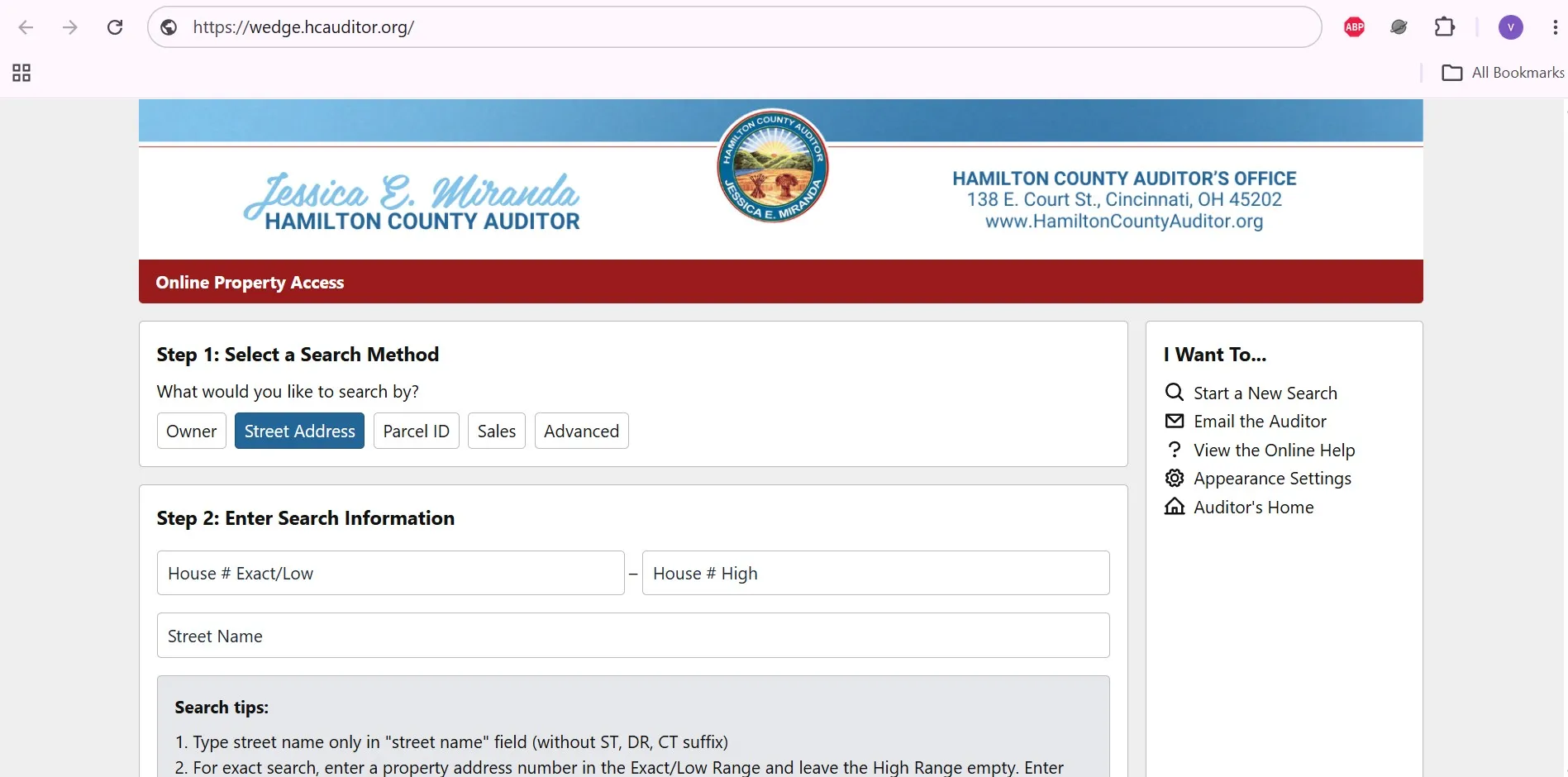
Enter the house number in the Exact or Low Range field and type only the main street name. Leave the High Range blank for one address and omit Street, Road, Drive, Court and similar suffixes.
How should I search an owner name?
Use the legal name as it appears on the deed. Enter the last name followed by the first name. Partial entries can help when a middle initial, trust name, company suffix or spelling is uncertain.
Why does my address not appear?
The USPS address may differ from the parcel record, a commercial parcel may cover several mailing addresses, or an old parcel may have been divided, consolidated or retired. Search a nearby range and use aerial parcel layers.
How long is a Hamilton County parcel number?
The official property-search instructions say most Hamilton County parcel numbers contain 13 characters. Enter the full identifier when searching a specific parcel.
Are CAGIS property lines exact?
No. Auditor aerial imagery and CAGIS lines are approximate. Use the deed legal description and a licensed surveyor when exact boundary placement matters.
Who handles Hamilton County property-tax payments?
The Hamilton County Treasurer bills and collects property taxes. Use the Auditor for parcel records, appraised values, exemptions and tax-distribution information.
What is changing in the 2026 triennial appraisal?
The 2026 update uses market-sales analysis without the full physical viewing used during the 2023 reappraisal. The county says the updated values become effective on January 2027 tax bills.
How do I challenge the appraised value?
Use the Hamilton County Board of Revision during the applicable filing period. Submit evidence that supports the requested market value rather than arguing only that the tax bill is too high.
What is the Hamilton County transfer fee?
The county lists a $3-per-$1,000 conveyance and permissive fee plus a 50-cent transfer fee for each parcel described in the deed or legal document.