Fairfield County Parcel Lookup, Tax Bills, GIS Maps and Auditor Records
Search a Fairfield County property by parcel number, owner name or street address, then review valuation, legal-description data, owners, buildings, sales, permits, agricultural use, tax bills, payments, distributions and special assessments.
This guide explains the useful information before linking to each live county action. Use the official systems only when you are ready to search, pay, download a record, submit a correction or complete a county form.
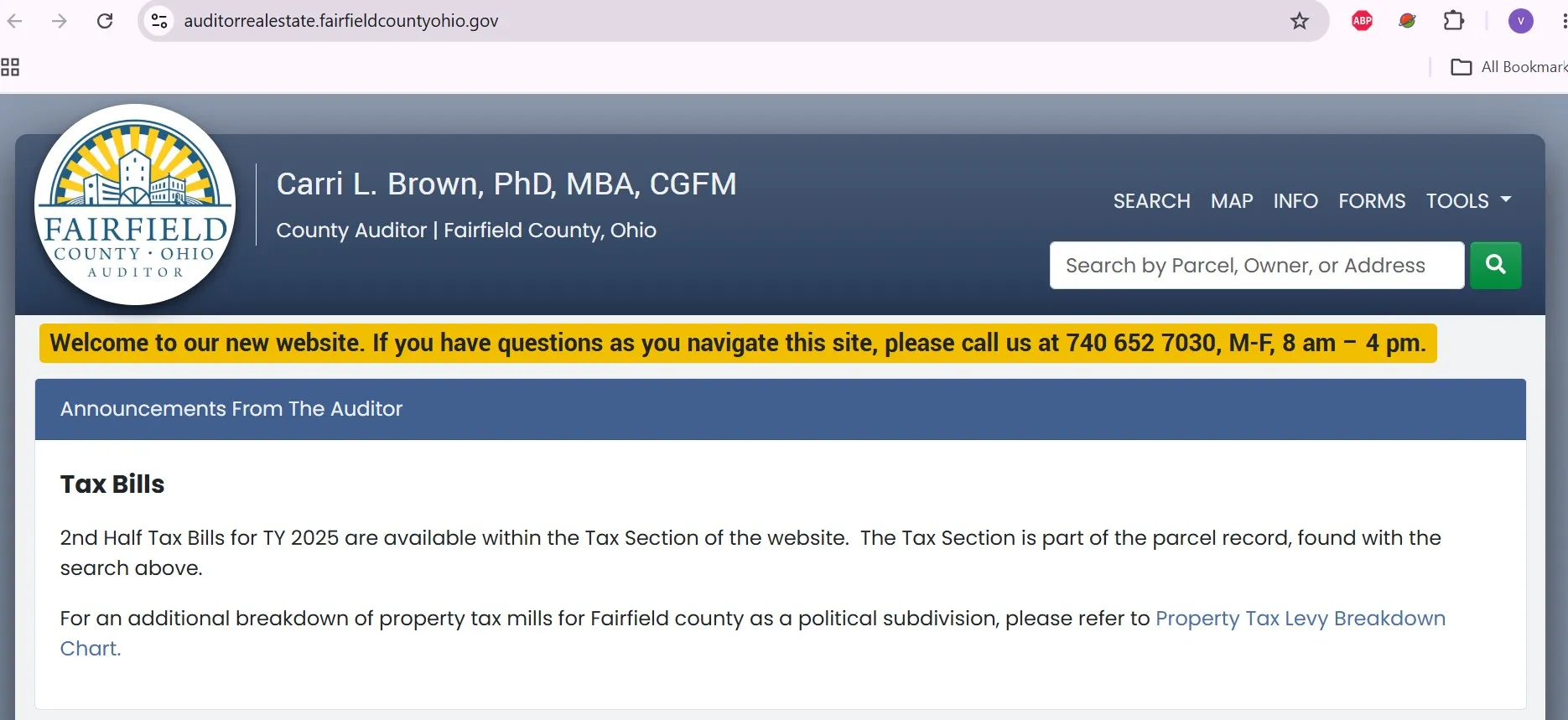
auditorrealestate.fairfieldcountyohio.gov pages instead of relying on screenshots or instructions from the retired interface.
Approximately 75,021 parcels.
Monday–Friday
8 a.m.–4 p.m.
Which Fairfield County property tool should you open?
Use Auditor Property Search and save the parcel number after confirming the correct result.
Use the GIS Parcel Viewer for visual location, adjoining parcels and aerial context.
Review the parcel Tax section, then use the Treasurer for payment and posting questions.
Auditor, Treasurer, Recorder, Map Room or Board of Revision?
| What you need | Correct office | Prepare first |
|---|---|---|
| Owner, parcel, appraised value or building data | County Auditor Real Estate | Parcel number, owner or address. |
| Tax balance, due date, payment, receipt or escrow | County Treasurer | Parcel number and tax year. |
| Deed, mortgage, lien, release or easement | County Recorder | Owner names, transfer date and parcel clues. |
| Legal-description approval or map research | Auditor Map Room | Prepared deed, legal description and survey. |
| Formal complaint about market value | Board of Revision | Current value, requested value and evidence. |
| Exact property line or corner location | Ohio-registered land surveyor | Recorded deed, plat and prior survey. |
How to search Fairfield County property records correctly
Best search method by situation
Best for exact tax, deed, GIS, form and office matching.
Best when the physical location is known but ownership is not.
Useful for finding multiple parcels owned by one person or entity.
Best for vacant land, adjacent lots and properties without a clear address.
Useful for comparable sales, buyers, sellers and date ranges.
Useful for district, acreage, legal and residential research.
Fairfield County Advanced Search for sales, districts and property features
| Filter group | Available criteria | Useful purpose |
|---|---|---|
| Sales | Sale date, price, buyer, seller and valid-sale status. | Build a recent comparable-sales list. |
| Location | Tax district, city or township, school district, neighborhood and subdivision. | Separate properties with similar mailing addresses but different tax areas. |
| Land | Land property class and acreage range. | Locate agricultural, vacant or larger-acreage parcels. |
| Legal | Legal-description keywords. | Search subdivision, lot, range or township descriptions. |
| Residential | Year built, living area, bedrooms, baths, stories and style. | Compare properties with similar physical characteristics. |
Comparable-sale research sequence
No Fairfield County property result found? Try these fixes
What the Fairfield County property record sections mean
| Record section | What it shows | What to verify |
|---|---|---|
| Location | Parcel, owner, site address, city or township and school district. | The result is the intended property and taxing area. |
| Deeded owner address | Mailing information tied to recorded ownership. | Compare with the newest Recorder document after a transfer. |
| Taxpayer address | Where tax correspondence is directed. | This can differ from the property and deeded-owner addresses. |
| Valuation | Appraised 100% and assessed 35% land, improvement and total values. | Review both current and historic values. |
| Legal | Legal-description reference, land use, neighborhood, occupancy and exemption status. | The portal warns this text is not for use on legal documents. |
| Owners | Owner names and percentage ownership where available. | Use the recorded deed for legal ownership conclusions. |
| Residential | Style, stories, year built, rooms, baths, living area, basement, heat and construction. | Look for factual errors that affect valuation. |
| Permits | Permit-related property information received by the assessment system. | A missing entry does not prove that no permit exists. |
| Agricultural | Agricultural and CAUV-related land information where applicable. | Land-use categories and acreage match the actual operation. |
| Commercial | Commercial building and valuation characteristics. | Use, area, occupancy and improvement information. |
| Improvements | Garages, sheds, pools and other taxable site improvements. | Removed or damaged improvements are not still listed incorrectly. |
| Sales | Transfer dates, buyer, seller, instrument data, price and sale-validity codes. | A displayed price is not automatically an arm’s-length sale. |
| Land | Pricing land type, frontage, depth, acreage, square feet and value. | The portal states these figures are for valuation and not legal survey acreage. |
| Tax | Charges, reductions, credits, amounts billed, payments and balance due. | Tax year, first half, second half and delinquent columns. |
| Tax distribution | How the net general tax is distributed among taxing units. | Do not confuse distribution percentage with the effective rate. |
| Special assessments | Charges certified by outside agencies and added to the bill. | Contact the listed assessment agency when disputing the charge. |
How to use the Fairfield County GIS Parcel Viewer
Search or zoom to the property and compare its parcel number with the text record.
Click nearby parcels to identify vacant lots, parent parcels and properties sharing one address.
Compare visible roads, structures and land features without treating the image as a survey.
Map workflow for a difficult parcel
Fairfield County tax bill, credits, payment and due dates
February 19, 2026.
July 30, 2026.
How to read the parcel Tax section
| Tax row | Meaning | Practical check |
|---|---|---|
| Gross tax | Tax calculated before reduction factors and owner credits. | Do not use this as the amount to pay. |
| Reduction | Tax-reduction factors applied to qualifying levies. | This helps explain the difference between gross and effective tax. |
| Effective tax | Tax after reduction factors but before several credits. | Still not necessarily the billed amount. |
| Inflation Cap Credit | A 2026 credit shown on eligible second-half bills under Ohio property-tax reform. | Review the second-half column and any resulting overpayment. |
| Non-business credit | A state-authorized credit applying to qualifying property and levies. | Not every property or levy receives the same treatment. |
| Owner-occupancy credit | Credit for an approved qualifying principal residence. | Confirm the parcel record shows owner-occupied status. |
| Homestead reduction | Tax reduction from an approved Homestead Exemption. | A zero may mean the parcel is not approved or the tax year is not yet reflected. |
| Net general | General real-estate tax after applicable reductions and credits. | Special assessments are added separately. |
| Special assessments | Charges certified by other public entities. | Use the assessment contact rather than assuming the Auditor created it. |
| CAUV recoupment | Potential recapture after agricultural-use status changes. | Contact the CAUV department before a sale or land-use change. |
| Penalty and adjustments | Late penalties or other account adjustments. | Ask the Treasurer about remission or payment-posting issues. |
| Billed | Total charge for the selected half or year. | Compare with payments and balance due. |
| Payments made | Payments posted to the tax account. | A recent payment may require processing time. |
| Due | Current remaining amount in that column. | Verify delinquent and current-year columns before paying. |
Inflation Cap Credit and full-year prepayment
Treasurer payment methods and current fees
| Method | How it works | Important detail |
|---|---|---|
| Online e-check | Pay through the Treasurer’s MuniciPay system. | Current published fee: $1. |
| Online card | Pay by supported debit or credit card. | Current published fee: 2.35%. |
| Phone | Use the Treasurer’s payment number at 740-279-3552. | Confirm parcel and amount before authorizing. |
| In person | 210 E. Main Street, Room 105, Lancaster. | Monday–Friday, 8 a.m.–4 p.m. |
| Escrow plan | Prepay estimated property taxes in monthly installments. | Monthly amounts can adjust after the actual second-half tax is known. |
| Drive-through | Collection-period service at 135 W. Chestnut Street. | Generally opens during the three weeks before a due date; confirm current hours. |
Fairfield County appraised value, assessed value and 2025 reappraisal
The Auditor’s estimate of 100% property value for assessment purposes.
Ohio real property is generally assessed at 35% of appraised value.
Depends on district rates, reduction factors, credits, assessments and recoupment.
Fairfield County completed a state-required sexennial valuation review for tax year 2025. Those values affect taxes payable during 2026. The parcel record can also display a starred 2026 value column for the current assessment cycle.
Check factual data before arguing market value
Use this route for wrong square footage, an incorrect address, a removed structure or another factual mistake.
Use market evidence when the property facts are accurate but the appraised value appears unsupported.
Fairfield County Board of Revision evidence and filing preparation
Evidence that answers the Board’s real question
| Evidence | Strong version | Weak version |
|---|---|---|
| Recent purchase | Contract, closing statement, conveyance data and sale circumstances. | Listing price or unaccepted offer. |
| Professional appraisal | Complete appraisal with comparable and adjustment analysis. | Automated online estimate. |
| Comparable sales | Similar location, use, age, size, condition and valid sale timing. | Neighboring properties selected only because their values are lower. |
| Condition | Dated photographs and inspection or contractor documentation. | Undated close-ups without property identification. |
| Repairs | Itemized professional estimates for significant deficiencies. | Owner-created totals for routine maintenance. |
| Income property | Reliable income, vacancy and expense statements. | Unsupported rent or expense claims. |
Lancaster, OH 43130
Fairfield County Homestead and owner-occupancy records
Provides property-tax relief for qualifying seniors, permanently disabled owners, disabled veterans and certain surviving spouses.
A separate credit for an approved principal residence and qualifying levies.
Homestead application preparation
Fairfield County CAUV renewal and land-use categories
The official CAUV renewal fact sheet explains how acreage from the Land Use Calculator should be transferred into Section 6 of the renewal application. Some land types must be combined because the application does not have a separate line for every calculator category.
| Land category | County explanation | Application treatment |
|---|---|---|
| Cropland | Commodity crops, hay, nursery stock, vegetables, apiculture or flowers. | Commodity crops or hay generally use lines 1 or 2; other listed agricultural activities can use line 6. |
| Pasture | Land used for commercial animal husbandry. | Report on line 3. |
| Woodland | Wooded land not under an approved timber plan. | Report on line 4. |
| Timber plan | Wooded land qualifying through a timber-management plan. | Report on line 5. |
| Homesite | Land supporting a dwelling, with one acre set aside for each dwelling. | Combine on line 7 with low-intensity residential land. |
| Low-intensity residential | Yard or other land around a dwelling that is not farmed. | Combine on line 7 with the homesite. |
| Right of way | Land along a road edge. | Report on line 8. |
| Waste, pond or stream | Land unsuitable for farming or building, pond acreage and stream acreage. | Report on line 8. |
| Contract conservation | Land under CRP, CREP or another qualifying FSA contract. | Report on line 9. |
| Voluntary conservation | Land voluntarily protected to reduce or prevent soil erosion. | Report on line 10; the fact sheet notes a limit of 25% or less of total acreage. |
Fairfield County deed-transfer steps and conveyance fees
$4 per $1,000 of consideration when money changes hands.
$0.50 per parcel for exempt and non-exempt transfers.
108 N. High Street, Lancaster.
Fairfield County lot split and new parcel workflow
Fairfield County deeds, mortgages, liens and ownership research
Best for parcel identity, ownership reference, assessment, sales and tax-related information.
Best for the actual deed, mortgage, easement, lien, release and recorded legal document.
What to do after substantial Fairfield County property damage
Fairfield County parcel, tax and conveyance mini-tools
Search-method helper
Assessed-value calculator
Basic tax-planning estimate
Conveyance-fee estimate
Fairfield County Auditor addresses, departments, hours and map
Lancaster, OH 43130
Monday–Friday, 8 a.m.–4 p.m.
Lancaster, OH 43130
Monday–Friday, 8 a.m.–4 p.m.
| Department | Phone | Best reason to call |
|---|---|---|
| Finance / general Auditor | 740-652-7020 | General Auditor administration and office routing. |
| Real Estate Assessment | 740-652-7030 | Property search, values, parcel data, BOR and CAUV. |
| GIS | 740-652-7055 | Parcel Viewer, layers and GIS data. |
| Map Room | 740-652-7060 | Legal-description approval, maps and lot-split support. |
| Treasurer | 740-652-7140 | Tax bill, payment, escrow, penalties and receipts. |
| Recorder | 740-652-7100 | Recorded deeds, mortgages, liens and releases. |
Fairfield County official property resources
Fairfield County Auditor property and tax FAQs
Where is the official Fairfield County property search?
Use the new Fairfield County Auditor Real Estate Assessment portal at auditorrealestate.fairfieldcountyohio.gov.
How can I search a property?
Use a parcel number, owner name or property address. Advanced Search also supports sales, location, land, legal and residential criteria.
How should I type an owner name?
Begin with the last name. The official form labels owner searches in last-name-first-name order.
Where is my second-half tax bill?
Open the parcel and review its Tax section. The portal states that second-half tax bills for tax year 2025 payable in 2026 are available there.
When are second-half taxes due?
Fairfield County second-half real-estate taxes are due July 30, 2026.
What is the Inflation Cap Credit?
Eligible parcels may receive a credit on the second-half bill. A resulting full-year overpayment is generally carried forward automatically unless an available refund is requested.
Are parcel-map lines legally exact?
No. Use the GIS map for location research and a professional survey for boundary-sensitive work.
How do I challenge the appraised value?
Review the parcel facts and market evidence, then use the Fairfield County Board of Revision process and current DTE complaint form.
What are the conveyance fees?
The official fact sheet lists $4 per $1,000 of consideration plus 50 cents for every parcel transferred.
Does the deed need Map Room review?
Yes. The county fact sheet says legal-description approval from the Map Room is a prerequisite for transfer.
Where can I find deeds and liens?
Use the Fairfield County Recorder or the official county land-record search. Start with the Auditor parcel number and owner information.
What is the Fairfield County Auditor phone number?
Finance and Administration is 740-652-7020. Real Estate is 740-652-7030, GIS is 740-652-7055 and the Map Room is 740-652-7060.