Lake County Property Lookup: Search Parcels, Values, Taxes and GIS Maps
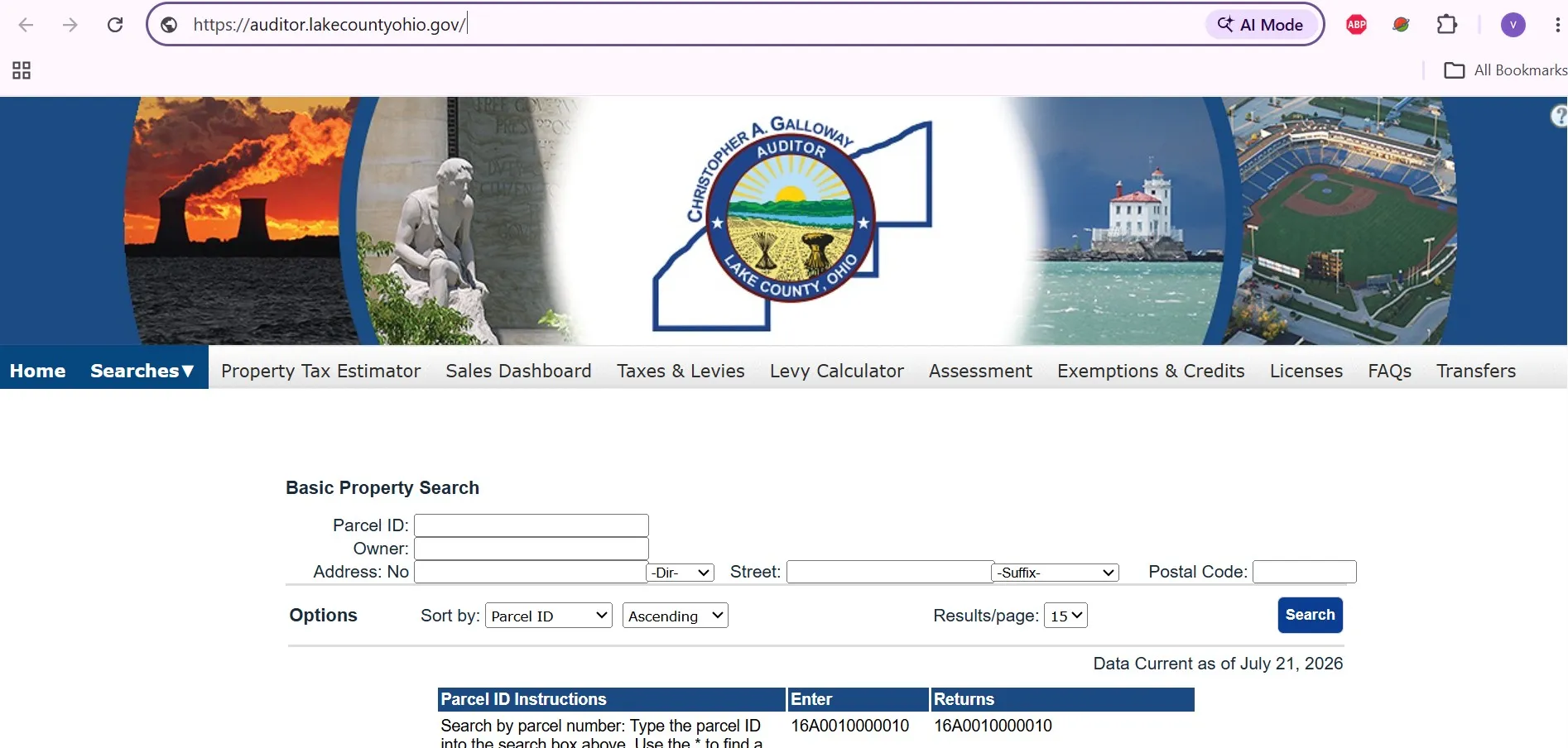
The Lake County Auditor property search can connect a parcel ID, owner name or street address with ownership, appraisal, transfer, tax and property-characteristic information.
This guide explains how to search correctly, interpret the record, use Lake Navigator, resolve failed searches and reach the correct county office. Open official pages only when you are ready to perform a live search, submit a form, check a bill or complete another official action.
105 Main St.
Suite C101
Monday-Friday
8 a.m.-4:30 p.m.
Parcel ID, owner, address, advanced and sales.
Official information checked July 23, 2026.
What do you need from the Lake County Auditor?
Search by parcel, owner or address and save the exact parcel ID.
Identify the parcel through the Auditor, then use the Treasurer for the live bill and payment status.
Review property facts, collect market evidence and use the Board of Revision during its filing period.
Auditor, Treasurer, Recorder, Board of Revision or surveyor?
| What you need | Correct office | What to prepare |
|---|---|---|
| Owner, address, parcel ID, appraised value or property details | Lake County Auditor | Owner name, property address or parcel ID. |
| Tax bill, amount due, payment, penalty or payment plan | Lake County Treasurer | Parcel ID and tax-bill year. |
| Deed, mortgage, lien, easement or recorded document | Lake County Recorder | Owner name, document number, book/page or recording date. |
| Formal complaint about appraised market value | Lake County Board of Revision | Parcel ID, requested value and supporting evidence. |
| Exact property line, encroachment or survey stakes | Licensed surveyor | Deed, legal description, plat and prior survey. |
| Zoning, setbacks, building permit or legal use | Local city, village or township authority | Parcel ID, address and project description. |
How to search Lake County property records correctly
Which search option should you use?
Best for exact matching, tax research, official forms and repeated lookups.
Best for homeowners, buyers and people who know the physical location.
Best for finding property held by a person, estate, trust, LLC or business.
Best for narrowing records by available property and assessment criteria.
Best for market evidence, recent transfers and comparable-property research.
Best for vacant land, confusing addresses, nearby parcels and aerial context.
No Lake County property result found? Follow this order
How to read a Lake County Auditor property record
| Record field | What it means | What to verify |
|---|---|---|
| Parcel ID | The county identifier assigned to the taxable parcel. | Use it across Auditor, Treasurer, GIS, Recorder and forms. |
| Owner name | The ownership name currently carried in the Auditor database. | Compare with the latest recorded deed when it appears outdated. |
| Property address | The physical or site address associated with the parcel. | Do not confuse it with the tax-mailing address. |
| Legal description | Recorded wording used to identify the land. | Use the deed and survey for legal boundary questions. |
| Land value | The appraised value assigned to the land. | Review separately from buildings and improvements. |
| Building value | The value assigned to structures and improvements. | Check square footage, age, use, condition and additions. |
| Market value | The Auditor’s estimated fair market value for taxation. | This is not the amount of property tax due. |
| Assessed value | Ohio real property is generally assessed at 35% of market value. | Tax rates, credits and reductions affect the final bill. |
| Transfer history | Reported ownership changes and sale information. | Not every transfer is a normal arm’s-length sale. |
| Tax district | The combination of taxing jurisdictions applying to the parcel. | Nearby parcels may have different school or municipal districts. |
| Building details | Assessment characteristics such as size, year built, stories and garage. | Collect proof when a factual characteristic is incorrect. |
| Tax data | Tax calculations and distribution information tied to the parcel. | Use the Treasurer for the official live balance and payment status. |
Lake Navigator parcel maps, aerial imagery and boundary limits
Lake Navigator 3.0 provides interactive parcel research, land-record information, historical aerial imagery and more than 30 available map layers. Lake Nav 4.0 Beta offers a newer interface when the older viewer has problems.
Use the established interactive parcel viewer for map, land-record and aerial research.
Try the newer viewer when the 3.0 interface is unavailable or difficult to use.
Advanced users can obtain nightly updated parcel, centerline, address and jurisdiction data.
How Lake County property values are updated
Lake County reviews all real estate through a six-year sexennial revaluation and a three-year update between full revaluations. The last full revaluation was effective for tax year 2021, and the triennial update was completed for tax year 2024, payable in 2025.
Age, condition, living area, lot size, basement finish, baths, outbuildings and construction quality affect valuation.
Qualified sales of similar property help establish current market value in each neighborhood.
Properties with similar physical features can have different values because market conditions vary by area.
Review these facts before disputing value
Incorrect square footage, building data, demolition or ownership may require a supported record correction.
The data may be accurate while the market value remains disputed. That issue requires value evidence and the correct appeal route.
Lake County property taxes, August 5 deadline and payment routing
July 22-August 5, 2026: 8 a.m.-3:30 p.m., closed noon-1 p.m.
July 25 and August 1, 2026: 8 a.m.-noon.
Lake County Board of Revision evidence, filing and hearing rules
The Board of Revision is a three-member valuation panel made up of the Auditor, Treasurer and President of the County Commissioners or their representatives. Its purpose is to determine fair market value as of the applicable January 1 tax-lien date.
105 Main St., Suite C101
Painesville, OH 44077
Monday-Friday, 8 a.m.-4:30 p.m.
Filing routes explained from the official packet
The preferred paperless filing method requires an email address and must be completed before the deadline.
A manually completed complaint requires a signature and notary seal unless valid electronic filing rules apply.
A mailed complaint must bear a timely United States Postal Service postmark. Private carrier meter dates do not establish timely filing.
Strong and weak evidence from the BOR packet
| Evidence | How it may help | Important limitation |
|---|---|---|
| Recent qualifying sale | A sale within about 24 months of the lien date between unrelated willing parties can provide strong market evidence. | Sheriff sales, family transfers and other forced or nonmarket transfers may not qualify. |
| Formal appraisal | A qualified appraiser’s opinion as of the tax-lien date can directly support the requested value. | The appraiser should be available to explain qualifications and methodology. |
| Documented damage | Records of serious damage within the prior three years may explain reduced value. | A general condition complaint without valuation evidence may be insufficient. |
| Unadjusted comparable list | Can help an appraiser identify market evidence. | A simple list without adjustments for age, size, condition and location generally does not prove value. |
| Listing price | Shows what a seller hoped to receive. | An unsold listing is not an arm’s-length transaction and does not establish market value. |
| Neighbor’s Auditor value | May identify a property worth researching. | The Board cannot decide the subject’s market value only from another parcel’s assessment. |
Procedure details users often miss
Lake County Homestead Exemption amounts, income and documents
Qualifying market value reduction of $29,000.
Qualifying market value reduction of $58,000.
$41,000 of prior-year Ohio adjusted gross income for applicant and spouse, unless grandfathered.
Standard eligibility checklist
Lake County document requirements
| Applicant situation | Documents commonly needed | Lake County detail |
|---|---|---|
| Age-based applicant | Driver’s license, Ohio ID, birth certificate or passport. | Lake County requires a photocopy of proof of age. |
| Disabled applicant | DTE 105E or qualifying disability evidence. | The disability must meet the permanent-and-total standard. |
| Trust or life estate | Pages showing the type of trust or life-estate ownership. | Certain irrevocable trusts may not qualify. |
| Income-tested application | Applicant and spouse Ohio income information for the required prior year. | Lake County recommends filing after the state income-tax return is completed. |
| Disabled veteran | DTE 105I plus qualifying VA service-connected disability documentation. | The enhanced program requires 100% disability or compensation at the 100% level. |
105 Main St., Suite C101
Painesville, OH 44077
Lake County owner-occupancy credit for a primary residence
Homeowners who own and occupy their home as their principal Ohio residence on January 1 may apply for the owner-occupancy reduction on qualifying levies. A homeowner and spouse may receive the reduction on only one home.
Use DTE 105C or the Lake County SmartFile paperless filing system.
The owner-occupancy application is often completed during a property transfer, but buyers should confirm that it was actually submitted.
Lake County CAUV eligibility, woodland and annual renewal
| Requirement | Official rule | What to prepare |
|---|---|---|
| Ownership | The applicant must own the land as of January 1 of the application year. | Current deed and parcel information. |
| Prior agricultural use | The land must have been in commercial agricultural production for the prior three years. | Crop, livestock, lease and production records. |
| Less than 10 acres | Average gross agricultural income must generally be at least $2,500, or anticipated income must meet the rule. | Gross receipts and income documentation. |
| Woodland over five acres | Mixed-use woodland over five acres may require a Woodland Management Plan to qualify as commercial timber. | Management plan and farming-unit information. |
| Commercial timber only | Must generally include at least 10 acres and a Woodland Management Plan. | Forestry plan and commercial-use records. |
| Annual renewal | DTE 109A renewal is due by the first Monday in March each year. | Current land-use and production information. |
| Conversion | Converted land can incur recoupment equal to the prior three years of tax savings. | Contact the Auditor before changing use or selling. |
Lake County damaged-property value reduction and filing deadlines
DTE 26 allows an owner to request a temporary valuation deduction when real property is destroyed or damaged. The allowed percentage depends on the quarter when the damage occurred.
| Damage occurred | Application deadline | Percentage of value loss considered |
|---|---|---|
| January-March | December 31 | 100% |
| April-June | December 31 | 75% |
| July-September | December 31 | 50% |
| October-December | January 31 of the following year | 25% |
DTE 26 information and evidence checklist
Lake County rental-property registration and the 60-day update rule
Residential rental property includes land with one or more dwelling units rented solely for residential purposes, mobile-home parks and sites where lots are leased for residential mobile homes or recreational vehicles. Hotels and college dormitories are excluded.
The county registration is one time and has no filing fee.
Ownership and agent information must be updated within 60 days of a change.
Failure to file or update can result in a $50 special assessment following each affected tax bill.
Information required on the official form
Lake County conveyance fees, DTE forms and transfer procedure
$4 per $1,000 of taxable consideration, rounded according to county instructions.
$0.50 per parcel.
A separate check is required for Auditor fees when submitting a transfer.
Required forms by transfer type
| Document | When it is used | Important fields or requirement |
|---|---|---|
| DTE 100 | A transfer subject to the real-property conveyance fee. | Grantor, grantee, addresses, buildings, sale conditions, consideration and owner occupancy. |
| DTE 100EX | A transfer claimed to be exempt from the conveyance fee. | State the applicable statutory reason and provide supporting records when requested. |
| DTE 101 | The grantor received Homestead during the current or prior tax year. | Submit with the conveyance statement. |
| DTE 102 | The property received CAUV during the current or prior tax year. | Submit with the conveyance statement and understand possible recoupment. |
| Previous recorded deed | Non-exempt metes-and-bounds transfers reviewed by Tax Map. | Provide a stamped and recorded copy when required. |
DTE 100 details users often overlook
Lake County deeds, mortgages, liens and property-fraud alerts
Use the Auditor property record to identify the parcel, owner and valuation. Use the Recorder when you need the actual deed, mortgage, lien, release, easement or another recorded land document.
| Question | Best source | Why |
|---|---|---|
| Who is currently listed as owner? | Auditor property search | Provides fast parcel and ownership lookup. |
| What does the legal deed say? | Recorder document | Contains the actual recorded conveyance language. |
| Is there a recorded mortgage or lien? | Recorder search | Mortgages, liens and releases are recorded instruments. |
| Where is the exact boundary? | Deed, plat and survey | GIS parcel lines are not survey accurate. |
| Can I receive a name-based recording alert? | Recorder Property Fraud Alert | The Recorder administers the county’s document alert service. |
105 Main Street
Painesville, OH 44077
Lake County property-search, value and conveyance helpers
Choose a property-search method
Conveyance-fee estimate
Property-value change
Find the correct office
Lake County Auditor address, phones, hours and office map
105 Main St., Suite C101
Painesville, OH 44077
Monday-Friday
8 a.m.-4:30 p.m.
Confirm county-holiday closures and department-specific filing times before visiting.
| Department | Phone | Use it for |
|---|---|---|
| General / Real Estate | 440-350-2532 | Transfers, owner address, assessments, owner occupancy and general information. |
| Appraisal / Board of Revision | 440-350-2221 | Property values, assessment data, complaints, abatements and TIF questions. |
| Homestead | 440-350-2536 | Homestead eligibility, forms and filing questions. |
| Agricultural / CAUV | 440-350-5845 | CAUV, agricultural districts and forestry. |
| Tax distributions | 440-350-2526 | Levies, rates, settlements and tax distributions. |
| Treasurer | 440-350-2516 | Tax bills, payments, penalties and payment plans. |
| Recorder | 440-350-2510 | Deeds, mortgages, liens and recorded documents. |
| GIS | 440-350-5970 | Lake Navigator, GIS layers, map accuracy and spatial data. |
Bring these details when visiting
Dog licenses, tax estimators, weights and measures and public records
The Auditor issues dog licenses and provides an online purchasing route through the county’s licensing provider.
Use the official property-tax estimator and levy calculator for planning, not as a substitute for a current bill.
The Auditor tests and inspects commercial scales, fuel meters and packaged consumer goods.
Related Northeast Ohio county auditor guides
These links are useful when a property is near a county boundary, an owner holds parcels in several counties or a user opened the wrong county search.
Official Lake County live-action resources
The important procedures and PDF details are explained above. Use these links for live searches, current forms, payments, submissions and final verification.
Lake County Auditor property-search FAQs
Where can I search Lake County Auditor property records?
Use the official Lake County Auditor Basic Property Search. It supports parcel ID, owner-name and property-address lookup, plus Advanced Search and Sales Search.
How do I search by owner name?
Enter the full owner name or part of it in the Owner field. Use an asterisk as a wildcard when part of the spelling or legal ownership format is uncertain.
How do I search by property address?
Enter the house number and main street name. Leave off the street suffix for better results and use a wildcard when the street spelling is uncertain.
Where can I view Lake County parcel maps?
Use Lake Navigator 3.0 or Lake Nav 4.0 Beta through the official Lake County GIS Department.
Are Lake County GIS parcel lines exact?
No. Lake County says the parcel-ownership layer is not survey accurate. Hire a licensed surveyor for exact boundaries.
When are second-half property taxes due in 2026?
The official deadline is August 5, 2026 for second-half 2025 real-estate taxes. A United States Postal Service postmark is accepted.
How do I challenge the appraised value?
File DTE 1 with the Lake County Board of Revision during the January 1 through March 31 filing period and support the requested value with qualifying market evidence.
What is the 2026 Homestead amount?
The standard 2026 market-value reduction is $29,000. The enhanced qualifying disabled-veteran reduction is $58,000.
What is Lake County’s conveyance fee?
The county lists $4 per $1,000 of taxable consideration, rounded according to its instructions, plus 50 cents per parcel.
What is the Auditor’s phone number and address?
Call 440-350-2532. The office is at 105 Main Street, Suite C101, Painesville, Ohio 44077, with general hours Monday through Friday from 8 a.m. to 4:30 p.m.