Delaware County Property Lookup: Search Parcels, Values, Taxes and GIS Maps
The Delaware County Auditor property system helps connect an owner name or address with parcel identification, property valuation, tax levy information, tax distribution and map-based real-estate records.
This guide explains the details users normally have to collect from several county pages and official forms. Open an official system only when you are ready to run a current lookup, submit paperwork, check a live bill or complete another official action.
145 N. Union St.
Delaware, OH 43015
Monday-Friday
8:30 a.m.-4:30 p.m.
Owner, address, parcel number and GIS map.
Official information checked July 22, 2026.
What do you need from the Delaware County Auditor?
Use owner, address or parcel search and save the exact parcel number.
Identify the parcel through the Auditor, then use the Treasurer for the live bill and payment status.
Verify property facts, gather market evidence and use the Board of Revision during its filing period.
Auditor, Treasurer, Recorder, Board of Revision or surveyor?
| What you need | Correct office | What to prepare |
|---|---|---|
| Owner, property address, parcel number, appraised value or property characteristics | Delaware County Auditor | Owner name, address or parcel number. |
| Tax bill, amount due, due date, payment status or payment receipt | Delaware County Treasurer | Parcel number and tax-bill year. |
| Deed, mortgage, lien, easement, land contract or recorded document | Delaware County Recorder | Owner name, instrument number, book/page or recording date. |
| Formal complaint about appraised market value | Delaware County Board of Revision | Parcel number, requested value and supporting evidence. |
| Exact boundary, fence line, encroachment or acreage dispute | Licensed surveyor or qualified property professional | Deed, legal description, plat and prior survey. |
| Zoning, setbacks, building permit or legal use | City, village, township or county zoning/building authority | Parcel number, address and proposed project or use. |
How to search Delaware County property records correctly
Which search method should you use?
Best for exact matching, repeat research, tax lookup and official forms.
Best for homeowners, buyers and users who know the physical location.
Best for finding parcels held by a person, estate, trust or business entity.
Best for vacant land, confusing addresses, nearby parcels and visual location research.
Useful for countywide, township, municipality, school district, subdivision or NCA research.
Useful for planning by tax district or school district, but not a final tax bill.
No Delaware County property result found? Follow this order
How to read a Delaware County Auditor property record
| Record field | What it means | What to verify |
|---|---|---|
| Parcel number | The county identifier assigned to the taxable parcel. | Use it across Auditor, GIS, Treasurer, Recorder and forms. |
| Owner name | The ownership name currently carried in the Auditor database. | Compare with the most recently recorded deed when it looks outdated. |
| Property address | The physical or site address connected with the parcel. | Do not confuse it with the owner’s tax-billing address. |
| Legal description | Recorded wording used to identify the property. | Use the deed, plat and survey for legal boundary work. |
| Land value | The Auditor’s appraised value assigned to the land. | Review separately from buildings and improvements. |
| Building value | The appraised value assigned to structures and improvements. | Check square footage, use, age, condition and major additions. |
| Market or appraised value | The Auditor’s opinion of full property value for tax purposes. | This is not the amount of tax due. |
| Assessed value | Ohio real property is generally assessed at 35% of appraised value. | Effective rates, reductions and credits affect the final bill. |
| Transfer history | Ownership changes and reported sale or consideration information. | Not every transfer is an arm’s-length market sale. |
| Tax district | The combination of local taxing jurisdictions applying to the parcel. | Nearby parcels may be in different school or municipal districts. |
| Building characteristics | Assessment details such as year built, size, stories, garage and construction. | Save proof when a factual characteristic is incorrect. |
| Sketch and photographs | County appraisal diagrams and imagery. | Check the image or inspection date before assuming it reflects current condition. |
Delaware County GIS parcel maps and property-line limits
The Auditor GIS application connects parcel records with map location. It is useful when text search is unclear, land is vacant, an address covers several parcels or nearby properties need to be compared.
Parcel location, nearby-property research, aerial context, road access and general map comparison.
Do not place a fence or resolve an encroachment from an online parcel line alone.
Contact the correct local zoning authority for legal use, setbacks and development rules.
How the Delaware County Auditor estimates property value
The Auditor’s valuation page explains three accepted appraisal approaches. The method given the most weight depends on the property type and the quality of available market, cost and income evidence.
Estimates replacement or reproduction cost, subtracts depreciation and adds land value. It is useful where sale or income evidence is limited.
Compares recent sales of similar properties while accounting for location, size, age, condition, quality and utility.
Analyzes the income a property can generate and is commonly relevant to commercial, industrial or rental property.
Review these facts before calling about value
Examples include incorrect square footage, a demolished building still listed or the wrong property class. Collect documents and request a record review.
The property facts may be correct but the value may still appear unsupported. Prepare appraisal or market evidence for the proper review process.
Delaware County property taxes, 2026 due date and Treasurer search
The Auditor provides valuation, levy and tax-distribution information. The Treasurer handles the actual bill, balance, payment, payment posting and due-date questions.
Using the official Auditor tax estimator
Delaware County Board of Revision filing, evidence and hearing rules
The Board is a three-member property-review panel made up of the Auditor, Treasurer and a County Commissioner or their representatives. It reviews real-property value as of the January 1 tax-lien date. It does not decide whether a tax bill is affordable.
145 N. Union St., 1st Floor
Delaware, OH 43015
Check the current filing notice before mailing.
How a complaint was accepted in the 2026 filing season
Mail had to be postmarked by March 31, 2026.
The county accepted complaints through the Auditor’s published email address.
The county accepted filings at 740-833-2899.
Complaint details that can prevent dismissal
Evidence to submit with the complaint
| Evidence | How it helps | Common mistake |
|---|---|---|
| Independent appraisal | Provides a professional opinion of market value. | Submitting only a cover page or automated estimate. |
| Closing statement and purchase contract | Supports a recent arm’s-length purchase price. | Leaving out sale conditions or related-party details. |
| Comparable sales | Shows market evidence from similar recently sold properties. | Comparing only neighboring Auditor values without actual sales. |
| Damage photographs | Documents condition not visible in county data. | Undated close-ups that do not identify the property. |
| Certified repair estimates | Explains major structural defects or repair burden. | Treating ordinary age-related maintenance as full value loss. |
| Income and expense statements | Supports an income-based argument for rental or commercial property. | Submitting unsupported estimated income. |
Procedure details extracted from the 2026 BOR rules
Delaware County Homestead Exemption eligibility and document checklist
Homestead is a statewide Ohio program administered by county auditors. It can reduce qualifying property taxes for eligible senior, disabled, veteran and surviving-spouse applicants.
Turn 65 by December 31 of the application year or meet the permanent-total-disability standard.
Own and occupy the property as the principal residence as of January 1.
Many new standard applicants must have qualifying 2025 household income of no more than $41,000.
Documents to prepare
| Applicant situation | Documents commonly required | Practical check |
|---|---|---|
| Age-based applicant | Photo ID such as driver’s license, Ohio ID or passport. | Confirm date of birth and current residence. |
| Disabled applicant | Disability certificate or qualifying state/federal disability evidence. | The proof must support permanent and total disability. |
| Income-tested applicant | Relevant Ohio income information for applicant and spouse. | Use the income year required for the application year. |
| Disabled veteran | VA disability documentation and DD214. | Use the enhanced-veteran application rather than the ordinary form. |
| Prior Ohio recipient who moved | Prior Homestead information and the appropriate addendum. | Do not assume the old parcel status automatically updates. |
| Surviving spouse | Death information and proof of the deceased owner’s prior eligibility. | Age and program requirements depend on the surviving-spouse category. |
Delaware County CAUV acreage, income, annual filing and recoupment
Current Agricultural Use Valuation values qualifying farmland according to agricultural use rather than ordinary fair-market development value. Enrollment is not automatic and must be maintained through the county process.
| Requirement | Program rule | What to prepare |
|---|---|---|
| Ten acres or more | Land devoted exclusively to qualifying commercial agricultural production may qualify. | Crop, livestock, conservation or production records. |
| Less than ten acres | Average gross agricultural income must generally be at least $2,500 for the prior three years. | Gross sales and agricultural-income documentation. |
| Use history | The land, not necessarily the same owner, must meet the qualifying use history. | Three years of land-use evidence. |
| Initial filing | File from the first Monday in January through the first Monday in March. | DTE 109 and the one-time $25 application fee. |
| Annual renewal | The property owner must reapply every year; there is no annual renewal fee. | DTE 109A and current use information. |
| Loss of qualification | Failure to renew or a nonqualifying use change may trigger three years of recouped tax savings. | Contact the Auditor before a sale or use change. |
The residence, home site and ordinary outbuildings remain valued at fair market value rather than CAUV.
Woodland cannot receive both CAUV treatment and a separate forestry tax program benefit.
CAUV follows the land, but the new owner must file correctly and understand possible future recoupment.
Delaware County damaged-property value reduction deadlines
DTE 26 allows an owner to request a deduction when real property is destroyed or damaged. The percentage depends on the calendar quarter in which the damage occurred.
| Damage occurred | Application deadline | Maximum deduction percentage |
|---|---|---|
| January through March | December 31 | 100% |
| April through June | December 31 | 75% |
| July through September | December 31 | 50% |
| October through December | January 31 of the following year | 25% |
Damage-evidence checklist
Delaware County residential rental registration and the 60-day rule
Residential rental property includes a single-family home, apartment, multifamily unit or a residential unit located on a mixed commercial parcel when money is exchanged for residential occupancy. Hotels and college or university dormitories are excluded from the county form’s definition.
Who files for each ownership type?
| Ownership | Person who may file | Important note |
|---|---|---|
| Individual owner | The owner | Provide owner name, address and phone number. |
| Several individual owners | One owner designated as contact | Only one contact person is required. |
| Trust or estate | Trustee, executor or administrator | The contact must be an individual rather than only an entity name. |
| Partnership | General partner | Include the person’s contact information. |
| LLC | Member, manager or officer | Do not list only the LLC without a responsible individual. |
| Corporation | Corporate officer | The filing contact is an individual. |
Information required by the county form
File within 60 days after notification following transfer, receipt of the property-tax bill or a change in required information.
The submitted ownership and contact information is considered public record.
Delaware County DTE 100, DTE 100EX and owner-occupancy questions
Delaware County’s official forms page provides the statewide DTE conveyance forms. Use DTE 100 for a transfer subject to the conveyance fee and DTE 100EX when a statutory exemption is claimed.
| Form item | What must be reported | Why it matters |
|---|---|---|
| Grantor and grantee | Names matching the deed or transfer instrument. | Connects the form with the legal transfer document. |
| Property address | Street address of the transferred property. | Helps identify the physical property. |
| Tax-billing address | Complete address where future tax bills should be sent. | The owner remains responsible even when a bill is not received. |
| Buildings and intended use | Building type or intended use when the land is vacant. | Supports classification and sale review. |
| Sale conditions | Gift, family relationship, life estate, land contract, trade or other special condition. | Explains whether the transfer reflects ordinary market value. |
| Consideration | Mortgage, assumed debt, cash and non-real-property portions. | Determines the amount on which a conveyance fee may apply. |
| Homestead status | Whether the grantor received Homestead during the current or prior year. | A DTE 101 may also be required. |
| CAUV status | Whether the property received CAUV during the current or prior year. | A DTE 102 may also be required. |
| Owner occupancy | Whether the new owner will use the home as a principal residence by January 1. | Failure to complete the application can delay the reduction. |
Common DTE 100EX exemption situations
To or from the United States, Ohio or a qualifying government agency or political subdivision.
A deed used only to correct a prior recorded deed or provide or release debt security.
Certain gifts between spouses, parent and child or qualifying related parties.
Certain transfers under court order, inheritance, devise or survivorship.
Certain transfers to or from a revocable trust when statutory requirements are satisfied.
Certain transfers involving property or easement interests below statutory value limits.
Delaware County Recorder search, older records and property-fraud alerts
The Auditor property record is useful for parcel identity and value. The Recorder is the correct office for the actual deed, mortgage, lien, easement, release, land contract, plat and other recorded instruments.
| Search method | How to use it | Important limitation |
|---|---|---|
| Name | Enter last name first and first name last. Search all spelling variations. | Business, church and school names may use special indexing formats. |
| Instrument number | Use the unique number assigned when a document is recorded. | You must first obtain the correct instrument number. |
| Book and page | Search using the volume and page reference. | Older references may require office assistance. |
| Online date range | The public site contains real-estate documents from 1990 forward. | Pre-1990 real-estate documents are available only through the Recorder’s Office. |
740-833-2460
145 N. Union St.
Delaware, OH 43015
Office hours are 8:30 a.m.-4:30 p.m., but the official Recorder page lists a 4 p.m. document-submission cutoff.
Free property-fraud alert
The Recorder offers an email-notification service that alerts a registered user when a new document bearing the registered name is recorded. The alert does not prevent fraud and applies only to documents recorded after registration.
Delaware County property-search, value and office-routing tools
Choose a search method
Property-tax planning estimate
Property-value change
Find the correct office
Delaware County Auditor address, phone, email, hours and map
Delaware, OH 43015
Monday-Friday
8:30 a.m.-4:30 p.m.
Fax: 740-833-2899
Confirm holiday closures and department-specific deadlines before traveling.
| Office | Phone | Use it for |
|---|---|---|
| Auditor | 740-833-2900 | Property search, valuation, BOR, Homestead, CAUV, rental and forms. |
| Treasurer | 740-833-2480 | Tax bills, payments, balances and due dates. |
| Recorder | 740-833-2460 | Deeds, mortgages, liens and recorded documents. |
Bring these details when visiting
Dog licenses, weights and measures, public data and query tools
Delaware County requires dog licenses to be renewed annually. The official 2026 page lists a standard price of $15 per tag.
The Auditor tests fuel pumps, commercial scales and price-scanning accuracy and accepts consumer complaints.
Download and Query Builder resources support countywide, township, municipal, school-district and subdivision research.
Related Central Ohio county auditor guides
These guides are useful when a property is near a county boundary, an owner has parcels in several counties or a user opened the wrong county search.
Official Delaware County live-action resources
The procedures and document details are explained above. Use these links for live searches, current forms, submissions and final verification.
Delaware County Auditor property-search FAQs
Where can I search Delaware County Auditor property records?
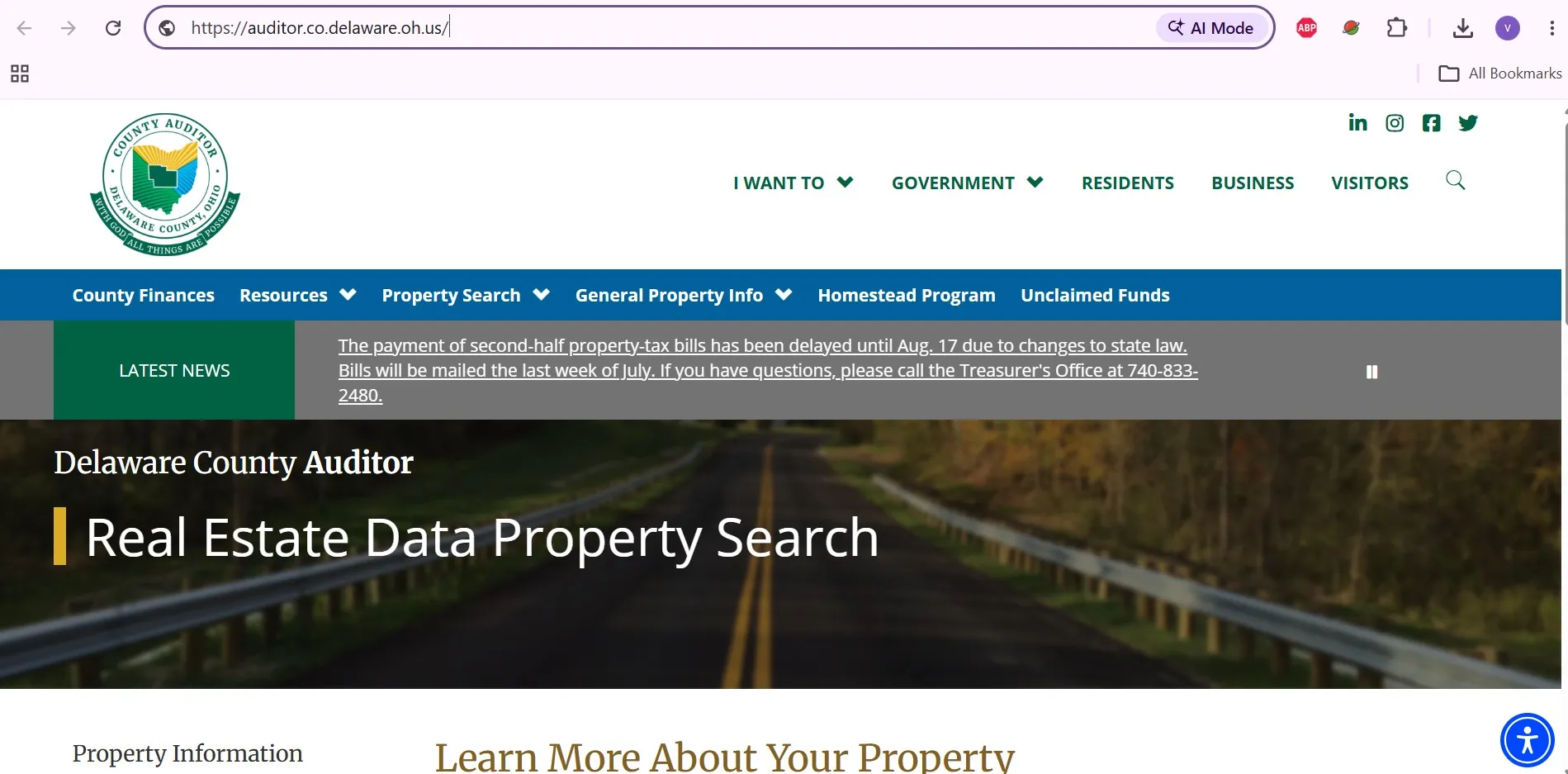
Use the official Real Estate Data Property Search page. It provides official owner, address and parcel-number search routes.
How do I search by owner name?
Enter the owner’s last name followed by the first name. You may also search by surname only when the complete legal format is uncertain.
How do I search by address?
Enter the house number and main street name. Omit street direction and suffixes such as N, S, E, W, St, Dr or Av on the first attempt.
Where can I find Delaware County GIS parcel maps?
Use the official Delaware County Auditor GIS application. It is helpful for parcel location, aerial review and nearby-property research.
Are the GIS parcel lines legally exact?
No. GIS is a public-research tool and does not replace a deed, recorded plat, title examination or licensed boundary survey.
When are second-half property taxes due in 2026?
The county announced an August 17, 2026 deadline. Bills are scheduled to be mailed during the last week of July.
How do I challenge the appraised value?
Use the Board of Revision during the official January 2 through March 31 filing period and support the requested market value with relevant evidence.
What evidence helps a value complaint?
A recent appraisal, purchase and closing documents, comparable sales, dated condition photographs, certified repair estimates and income records can be useful.
Do rental-property owners have to register?
Yes. The required owner, contact, street-address and parcel information generally must be filed within 60 days after the applicable notice, transfer, tax bill or information change.
What is the Auditor’s phone number and address?
Call 740-833-2900. The office is at 145 N. Union St., First Floor, Delaware, Ohio 43015, and general hours are Monday through Friday from 8:30 a.m. to 4:30 p.m.